






Elon Musk’s journey from co-founding Zip2 right back in the late 90s to building a multi-planetary empire can be seen as a tale of big, bold bets, a healthy dose of technological bravado and an unyielding drive to get things done.
But scratch beneath the surface of that story and you’ll find a deeper playbook at work – one that hints at just how the rules of wealth creation might change over the coming decades – especially for a country like Australia as it looks to find its feet in this increasingly high-stakes world of AI, space and clean energy.
As of right now, in October 2025, Musk’s net worth has soared to around US$490 billion or even a whacking $500 billion, depending on who you believe – all of which is largely tied up in his stake in Tesla, SpaceX and various related ventures.
Musk’s wealth did not build overnight, the truth is it’s the result of a series of incremental, calculated gambles on emerging infrastructure, cutting-edge energy systems, the digital finance space and wild visions for the future – all of which were worth taking the risk on.
A Snapshot of His Ascent (Zip2 → Tesla)
- Zip2 : Musk’s first major win came in 1999 when Zip2, a city guide software platform he co-founded with his brother, was snapped up by Compaq for a whopping US$307 million.
- PayPal / X.com: Musk then used the cash he got from the sale to help fund his vision for online payments – a project that eventually grew into PayPal – which was later bought out by eBay in 2002 for a cool $1.5 billion in shares.
- Tesla & SpaceX: Over the last ten years Musk has steered his focus towards electric vehicles, batteries, solar panels, self-driving systems and rocket tech. The result has been that Tesla has become one of the world’s most valuable automakers and SpaceX a basically unstoppable private space force.
That particular arc – from software to finance to clean energy and aerospace – is not just a story about one man, it’s a glimpse of what the next generation of billionaires might look like as they build across multiple layers of tech and new frontiers in space.
How Did Elon Musk Make His Money?- From Zip2 to Tesla

Zip2 exit : A blueprint for building real digital infrastructure
It was actually with Zip2 that Elon Musk had his first really meaningful commercial success. Founded in 1995 with his brother Kimbal and Greg Kouri, the company offered what was basically an early version of city guide software and mapping services to newspapers – allowing traditional media to attach all sorts of digital extras like directories, maps and local listings to their print editions.
By 1999, Compaq had come in and bought Zip2 for a cool US$307 million, leaving Musk with a tidy sum for his share ( roughly 7% ) of the deal – around US$22 million.
So why does this early success matter?
- It shows how the basic digital platforms – software, maps, directories – can actually scale and start raking in the cash.
- It gave Musk the dosh and credibility to take a punt on even more ambitious projects (like online banking).
- And it laid down a key principle: get in on the ground floor of emerging infrastructure and be prepared to reap the rewards as others build on top of it.
Australian parallel & lessons
Australia didn’t have a “Zip2” equivalent back then but the concept resonates strongly today in our push for national infrastructure in data, mapping, energy and connectivity. Some Australian examples:
- The New Payments Platform (NPP) runs real-time payments infrastructure and as of April 2025 supports over 25 million registered PayIDs.
- Initiatives in geospatial infrastructure, open data, GovPass identity schemes and national APIs show we believe digital “rails” (not just front-end apps) have enduring value.
- Firms like Nearmap (Australian aerial imagery + mapping) and PropTech platforms are building “map + place” layers on which apps plug in.
In a future of autonomous vehicles, drone delivery and AR city layers, whoever owns or controls map + location + routing APIs will have tremendous leverage—just as Zip2 owned early mapping & directory rails.
PayPal and the evolution of fintech: lessons for future digital currencies and AI-driven banking
After the Zip2 exit, Musk deployed much of his capital into X.com, an early experiment in online banking. It merged with Confinity’s PayPal in 2000 and by 2002 PayPal was sold to eBay for US$1.5 billion. Musk’s stake yielded around US$180 million.
That transition marked a shift from purely infrastructure (directories, mapping) to financial infrastructure—payment rails, account systems, remittances.
Key lessons from Musk’s PayPal era:
- Seamless user experience win: PayPal’s core value was letting people send money via email, bypassing friction. Musk went for simplicity—few fees, easy onboarding.
- Leveraging network effects & viral growth: They used referral incentives, embedded into eBay listings and partnerships to scale fast. PayPal became the default for online payments.
- Positioning for arbitrage & scale: He bet digital payments (cross-border, microtransactions, merchant payments) would outpace legacy banking. The Zip2 capital gave him a runway for experiments.
Australian fintech context & stats
- The Australian fintech sector is growing strongly. In 2024 the fintech market was valued at USD 4.10 billion and is forecast to reach USD 9.5 billion by 2033 (CAGR ≈ 8.90 %).
- Another source has the 2025 market at USD 11.78 billion and forecasts it to reach USD 23.69 billion by 2030 (CAGR ~15 %).
- The payments ecosystem in Australia is big: the payments market is USD 1.07 trillion in 2025 and USD 2.29 trillion by 2030.
- Australian fintech funding bounced back in Q1 2025 but deal volume is still below prior peaks—it had 13 deals, down from 18 in Q1 2024 (28 % decline).
- Regulatory frameworks in Australia are also changing: fintechs have to deal with Consumer Data Right (CDR) obligations, anti-money laundering / counter-terror financing (AML/CTF) rules and the emerging AI ethics and regulatory frameworks.
In Australia, several local firms are following PayPal’s playbook:
- Airwallex, founded in Melbourne, recently raised funding and is valued > US$6.2 billion, building payment infrastructure globally.
- Fintechs focused on payment clearing, cross-border remittance, micro-lending and regtech are the nimble vehicles riding on the rails that PayPal helped build.
Tesla – Redefining Mobility and Wealth Creation
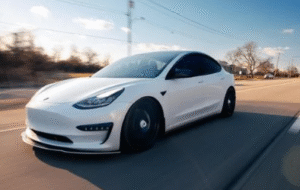
Electric cars and the clean-energy revolution
By making the leap into Electric Vehicles (EV’s), Tesla shifted Musk’s wealth creation away from software and finance and into the much more substantial realms of physical infrastructure, energy and mobility – areas which have a huge scale and the potential for ongoing, recurring revenue streams (sales, charging, battery, autonomy). This move signals a new paradigm: an ambition not just to sell cars, but to own and control the grids, data, autonomy stacks and energy flows that underpin the industry.
How Tesla’s Australian performance shows the tough road ahead and all the potential
Tesla has had a wild ride in Australia this year – and it’s a mix of bad news and good. These numbers both highlight the uphill battle and the potential upside of owning the infrastructure for mobility in a developed market.
Recent sales and market share
- In June 2025, Tesla delivered 4,589 vehicles in Australia – its best month in a year.
- The Model Y really started to take off, selling 3,457 units and growing by around 19% year-on-year.
- Model 3 sales were a bit of a letdown, at 1,132 units, with a drop of around 36% compared to the same time last year.
- In the first 6 months of 2025, Tesla sold 14,146 vehicles in Australia – down around 38.8 % compared to the same time last year.
- In July 2025, things took a dip, with only 555 Model Ys and 362 Model 3s finding new homes, and a total of around 917 units sold.
- The problem was largely down to delays in getting new Model Ys and Model 3s out of Tesla’s Shanghai factory.
- Tesla did have a bit of an advantage, with incentives to get people to buy – for example, until September this year, you could get a $2,000 trade-in discount on a brand new or second-hand Model Y, plus there were some more general lending and leasing deals available.
- Despite all the ups and downs, Tesla is still way out in front as Australia’s top EV seller. In the first 6 months of 2025, Model Y was the country’s best-selling battery-electric vehicle with 10,431 deliveries (despite a 16.7% drop in sales from January to July).
- That being said, BYD’s not giving up easily – their Sealion 7 is starting to give the Model Y a run for its money. In June, BYD sold 1,795 units compared to Tesla’s 3,457.
- On a bigger scale: EVs are making inroads in Australia. In 2024, around 9.65% of new cars sold were EVs (around 114,000 units).
- The Electric Vehicle Council is predicting that EVs will make up between 15% and 19% of the market by next year.
- In the first 6 months of 2025, EVs took around 7.6% of the new vehicle market (around 47,245 of 624,130).
- There’s even a report that in June 2025, plug-in vehicles (BEV + PHEV) accounted for around 15% of all new sales (13,169 BEVs and around 6,200 PHEVs).
All these numbers show just how volatile things are – and the challenge Tesla faces – but they also show the potential for upside: Tesla has a big lead in Australia but it’s starting to be challenged by new competitors, supply is an issue and the whole industry is still in a state of flux. Still, if Tesla can keep its hold on the charging, software, autonomy and grid services side of things, it could still come out on top.
How Tesla became more than a car company: Batteries, AI, Autonomy, Vertical integration
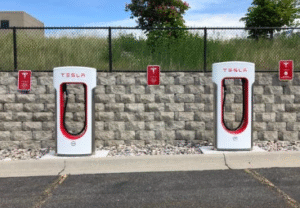
Tesla’s Vertical Approach, The Foundation for a “Moat” Around the Mobility Business
Battery & Energy Stack
Tesla’s vertical approach starts with building Gigafactories, manufacturing cells & developing chemistry – all neatly wrapped into energy storage (Powerwall, Powerpack, Megapack) within its own ecosystem. This not only fuels cars but enables grid services & long-duration storage too.
Supercharger Network & Energy Arbitrage
Tesla has a lock on the user experience with its proprietary Supercharger network – though this might change over time as it opens APIs or allows third party access under licensing or revenue-sharing models.
Over-the-air software & data control
Tesla scoops up a range of data from its vehicles – usage, telemetry, traffic, route optimisation and more. That vehicle becomes a node in a data mesh – handy for continuous updates, remote features deployments, and new service monetisation (autonomy, insurance, in-app features).
Autonomy & Robotics
The goal’s to create robotaxis, autonomous fleets and eventually full autonomous travel. As you’d expect, the software stack, sensor fusion, AI training loops, & vehicle-to-fleet coordination are going to become among Tesla’s most valuable assets.
Integration across Energy, Mobility & Storage
Imagine homes are solar & battery powered, and cars feed back into the grid… then you get a picture of how Tesla’s reach spans home, car & grid. The synergy enables arbitrage: timing, charging, discharging, and mobility.
Through this integrated model, Tesla doesn’t just earn from car sales – it can also grab margins from batteries, grid services, software, autonomy, and recurring subscription modules.
SpaceX – The Final Frontier
How SpaceX Contributes to Musk’s Fortune
Elon Musk’s shift from down-to-earth tech (software, energy, cars) to space business takes his empire from earthbound infrastructure to interplanetary infrastructure. SpaceX is now a key pillar in his wealth, making Musk more than just an automaker or energy kingpin – he’s a space economy builder.
- By 2025, SpaceX is expected to pull in US$15.5 billion in revenue, thanks to launch services, Starlink satellite internet & government contracts.
- Its growth is accelerating fast: we’re talking estimates of US$13.1 billion revenue in 2024 – or even higher depending on which industry forecast you read.
- Starlink has grown to over 6 million global users and is still going strong. As of mid 2025.
- And launch cadence is getting more frequent. In 2024, SpaceX launched a record-breaking 134 Falcon rockets (Falcon 9 + Falcon Heavy).
These figures show SpaceX is no longer a speculative side bet – it’s now a serious commercial force, adding meaningfully to Musk’s wealth and influence.
Australia & SpaceX: A New Partnership
Australia’s becoming a key player in SpaceX’s plans – and for Australia’s own space ambitions to catch up with Musk’s vision.
Partnerships & Contracts
- The Australian Defence Department inked a AUD 541,000 contract with SpaceX to get Starlink gear and data for a Royal Australian Air Force KC-30A tanker aircraft.
- Telstra, Australia’s biggest telco, teamed up with SpaceX/Starlink on a Starlink-to-mobile project – aiming to bring better connectivity to remote and regional areas.
- Several Australian payloads have taken to the skies on SpaceX missions – for instance, in June 2025, four Australian payloads got a ride on SpaceX’s Transporter-14 mission.
These moves show that Australia is stepping up from being just a consumer – to actually collaborating in that infrastructure.
Getting the infrastructure & regulations in line
- Australia signed a Technology Safeguards Agreement with the US and that’s meant to let foreign launch providers like SpaceX do business here, including having launches from Australia under certain safeguards.
- We’re talking about this framework allowing the Australian Space Agency to estimate that Australia could see up to a hundred rocket launches over the next decade.
- SpaceX has supposedly even been looking at using Australia for some of their Starship test operations – that would include landing and recovering the things off our coasts.
So we’re seeing Australia position itself as a potential launch hub – and both the geography and the regulations are offering SpaceX a pretty sweet deal for their expansion.
Acquisitions, Risks, and The Wild Speculations
Twitter/X – is this just a pretty big punt on the future or a new media empire
Elon Musk’s acquisition of Twitter (now rebranded as X) has got to be one of the most bold and most contentious moves he’s ever made – a sudden switch from energy and space to digital media, comms and real-time influence.
- He pulled off the takeover in October 2022 for a whopping US$44 billion of debt, equity and asset sales.
- Under his leadership, X is chasing subscription monetisation (think the “X Premium / Blue” thing), creator revenue sharing, ad reform, and integrating payments and financial services.
- Though – the transition has been a bit rocky – we’re talking about advertiser pullbacks, content moderation headaches and revenue rollercoasters.
- Yet Musk and his fans are saying it’s not just a social media platform – it’s infrastructure for public discourse, identity, payments and real-time AI driven experiences.
Australian angle & data
- In Australia, the regulatory environment for digital platforms is getting pretty tough (think mandatory news payments, consumer protections, competition law). Platforms like X have got to navigate Australia’s Online Safety Act, the News Media Bargaining Code, and all the other media regulation reviews that are going on.
- We’re projecting that local digital ad spend in Australia will hit AU$20.7 billion by 2025 – that’s growing at 7-10 % year on year. (Source: IAB Australia, 2025)
- Australian creators, media houses and small businesses are going to be attracted to platforms that offer integrated monetisation, payments and native commerce – that’s what X is trying to embed.
Risk vs Potential
- The biggest risk is cash flow – if the advertisers don’t come back and the subscriptions don’t take off then X could be a money pit.
- On the flip side – if X gets it right and can embed payments, identity, AI chat/assistant layers, live content & trading then it could actually become a super app for how we live our digital lives.
Real Estate, Dogecoin, and all the other weird and wonderful speculative bets
Beyond his show-stopping bets – Musk has also dabbled in a bunch of other stuff – and each one offers a little glimpse into how he thinks about his options.
- Dogecoin & crypto – Musk’s public cheerleading and price-moving tweets show how he sees crypto as a bit of fun and a financial lever.
- Real estate & repossessions – he’s been linked to some pretty high-profile property deals – and even foreclosures. That gives him some upside with a bit of leverage.
- Other ventures – Musk’s involvement in AI, neural interfaces (Neuralink), and tunnelling (The Boring Company) diversify him into the adjacent domains.
Australian-relevant speculative parallels and debates
- Aussie retail and institutional investors have been getting more and more exposed to crypto — crypto exchange volume in Oz hit a whopping AU$34 billion last year.
- Real estate speculation remains strong in coastal and regional areas, and some think that if big players like Elon Musk were to buy up strategic land (like near future transport or energy hubs) that could yield pretty big returns.
Controversies and Culture – Managing without Being a Drill Sergeant

The media can’t get enough of Elon Musk – for better or for worse
Elon Musk’s always been as polarising as he is brilliant. People either love or hate his management style which tends to push employees to the limit – long hours, tough deadlines and zero room for compromise.
We’ve heard from former Twitter/X staff about overnight shifts and abrupt changes in direction, and it’s not the first time we’ve seen this in places like Tesla and SpaceX where engineers have to put up with a relentless pace from Musk.
The media has some pretty strong opinions about this culture – some think it’s what drives innovation to new heights, while others reckon it’s just a recipe for burnout.
Over the last couple of years, there have been a few investigations that’ve highlighted some pretty serious concerns – things like worker burnout, safety risks in Tesla factories and high employee turnover at Twitter.
Why do investors let Musk get away with it?
Despite all the criticism, Musk’s still getting a lot of support from investors. Tesla’s valuation shot up to US$790 billion last year, and SpaceX is now worth over US$210 billion (making it the most valuable startup in the world).
Investors don’t care that Musk’s companies have had some ups and downs because they’re sitting on a bunch of mega trends like EV adoption, energy transition and space travel.
It’s a broader investor mindset – back the disruptor, not the diplomat. The people who are willing to take risks and push the boundaries (even if that means taking a few knocks along the way) are the ones who are going to attract the big money if they’re sitting on the right inflection point.
Australian parallels – lessons to be learned
In Australia, corporate governance is a hot topic right now:
- ASIC and APRA are introducing new rules to make companies be more transparent about their workplace culture, ESG and risk management.
- Australian Council of Superannuation Investors (ACSI) reckons that “toxic leadership and poor culture” are systemic investment risks that investors need to be aware of (according to its 2025 stewardship report).
- Startups in Sydney and Melbourne are wrestling with how to balance their scaling goals with their obligations around workplace safety, inclusion and sustainability.
Musk’s approach is a bit of a warning sign. If Australian companies want to scale up and get noticed on the global stage, they need to learn from the backlash – there’s no excuse for governance failures, even if you are innovating.
Falling over – getting back up again
Elon Musk’s story is as much about the failures as it is about the successes.
- The Zip2 sale was a big win, but his next play, X.com, nearly went bust before they pivoted to PayPal.
- SpaceX had three failed rocket launches before they finally got one into orbit in 2008 – Musk said if they’d had another failure, they’d have gone under.
- Tesla has had more than a few near-death moments – in 2008, it was looking like they were about to go under until a last-minute Daimler investment and a US$465 million loan from the US government saved them.
Musk looks at these failures as learning experiences – chances to test his resolve and make himself a better leader.
Biggest mistakes and lessons
Musk has admitted to errors:
- Overconfidence in timelines (“full self-driving by 2020”) damaged credibility.
- Aggressive scaling in Tesla’s “production hell” caused huge stress across the workforce.
- His Twitter/X takeover, while visionary, was one of the most financially reckless decisions of his career.
The lesson: even billionaires get execution wrong. What sets Musk apart is not error avoidance, but ability to persist and course correct at scale.
Australian lens: embracing failure culture
Australia has traditionally been more risk averse in entrepreneurship than Silicon Valley. But attitudes are changing:
- The Startup Genome 2025 report has Sydney and Melbourne in the global top 30 startup ecosystems, with venture funding doubling since 2020.
- Australian founders are adopting a “fail fast, pivot faster” mindset, just like Musk.
- Local success stories (e.g. Atlassian, Canva, Airwallex) show that resilience in global markets is rewarded — and Musk’s playbook of absorbing failures resonates with founders here.
H2: Lessons for Tomorrow’s Entrepreneurs
What Musk’s empire teaches about disruption
Elon Musk’s career illustrates three recurring themes:
- Own the infrastructure — Zip2 mapped cities, PayPal built payments rails, Tesla controls EV supply chains, SpaceX owns launch capacity.
- Scale through vertical integration — whether batteries, satellites or AI, Musk doesn’t rely on third parties.
- Think decades ahead — Musk’s wealth comes not from quarterly profits but from positioning around megatrends: clean energy, autonomy, space.
Strategies that apply to 2025–2040
Entrepreneurs looking to the next 15 years can apply Musk’s enduring strategies:
Vision as leverage
A bold, future-oriented narrative attracts capital, talent and regulators. Tesla’s 2030 clean energy vision keeps investors loyal despite volatility.
First-mover advantage in new markets
Early entry into EVs, private spaceflight and satellite broadband gave Musk a head start. By 2040 similar opportunities will emerge in quantum computing, climate-tech, biotech and orbital logistics.
Cross-domain arbitrage
Musk reused lessons and capital from one industry to jump into another. Future founders can cross pollinate between AI, finance, property tech and climate science.
Australian opportunities
Australia can apply Musk’s playbook in several sectors:
Clean energy and storage
Australia is the world’s largest per-capita solar market, with over 3.6 million rooftop systems by 2025. Scaling into battery manufacturing and vehicle-to-grid services could make local companies “Tesla-lite” players.
Fintech and digital payments
Australian fintech is projected to hit USD 9.5 billion by 2033, growing 9% annually. Local companies like Airwallex and Afterpay are already in the early PayPal phase.
Space economy
Australia signed a Technology Safeguards Agreement with the US in 2024, allowing foreign launches. The government expects 100 launches by 2035. Local entrepreneurs can get in on this supply chain.
AI and data infrastructure
AI investment in Australia is on track to reach A$1.3 billion by 2026, startups focused on AI safety, compliance and sector-specific applications will be the winners of tomorrow.
Futuristic Lens: What Musk’s Path Predicts for the Next Decades
Looking at Musk’s trajectory from the perspective of the 2050’s, Australia – and global markets – should keep an eye out for three on-going trends converging into one:
Infrastructure is the foundation of future wealth
Musk’s success isn’t about flashy products but about owning the underlying infrastructure that makes them possible : software platforms, energy grids, launch systems. We’re already seeing a rush into AI infrastructure and data centres over in Australia.
For example, the IT outlay in Australia is forecast to come in at AU$147 billion in 2025. Then there’s the AU$20 billion over five years that Amazon has put on the table to expand data-centre and cloud infrastructure here in the country.
The upshot is that getting a grip on the backbone (compute, energy, transport) is going to give you way more leverage than just churning out gadgets consumers want.
Cross-domain arbitrage: from finance to mobility to space
Musk never put himself in a box. Profits and expertise from one domain (like digital payments) helped him take a deep breath and leap into another (electric cars, rockets).
In Australia, tech companies and investors are increasingly combining fintech, cleantech, space tech and AI. The Australian Tech Leaders Survey (2025) says that a lot of founders are expecting these different tech areas to become even more intertwined.
In the long run, the winner won’t be a pure EV player or a pure AI firm – it will be a master of multiple ecosystems.
Australia’s place in the global push for sovereignty over data, AI & space
Australia is being pushed to move beyond just being a consumer of technology . Investment in AI in the country is forecast to hit A$1.3 billion by mid-2026 – after surging from A$668 million in FY24 – an increase of ~142% from FY22 to FY24.
Though, its not just that – of 450+ Australian enterprises surveyed, a whopping 72% say they’re not getting any real return on investment from their AI investments.
At the same time, Musk’s Starlink has become an integral part of Australia’s telecom network, signing up 200,000 users in remote areas and getting contracted by government agencies. Telstra has teamed up with SpaceX to bring satellite connectivity to mobile phones across regional Australia.
These developments seem to be hinting at a future where having sovereignty over data fabrics, algorithmic infrastructure and orbital assets becomes a game-changer in the global wealth stakes.
From Musk’s empire to Australia’s chance
Australia’s own path is echoing some of Musk’s key plays:
- AI & data: A$1.3 billion in AI investment by 2026 is a clear sign that the country is ready to own the next-gen digital infrastructure.
- EV adoption: EV penetration reaching 15% of new sales in June 2025 shows Australia is in line with Tesla’s clean-energy vision.
- Space industry: The Australian Space Agency projects 100 launches by 2035, with SpaceX partnerships already getting Australia into the orbit of the supply chain.
- Fintech growth: The Australian fintech sector is forecast to double in value by 2030 – echoing Musk’s PayPal-era lessons about transactional infrastructure.
Conclusion: The Road Ahead
Elon Musk’s path – from the humble beginnings of Zip2 to the dominance of Tesla and the orbital ventures of SpaceX – is more than just a tale of personal success. It is the blueprint for how future wealth will be created: by owning infrastructure, jumping between different industries and investing in tomorrow’s mega trends.
Getting a read on Musk’s past – a roadmap for his next big score
- Zip2 was a real eye opener: building the infrastructure for digital ecosystems – the ‘backbone’ of the internet – can give you a ton of leverage way beyond the product itself.
- PayPal proved to us that owning the trust and transaction flows in finance is the key to scaling wealth in the world of digital money.
- Tesla showed us that breaking into an industry aligned with the big trends of sustainability and government incentives can totally flip a market on its head.
- SpaceX takes the idea of playing with fire to new heights. When you’ve got vision and know how to execute, taking crazy risks at the edge of what’s possible can put you in a position to open up brand new markets worth trillions.
- X (Twitter) tells us that even if you’re taking on a wild new challenge that not everyone agrees with – it can pay off in the end if it turns into a foundation for identity, payments and conversation – useful stuff that people can’t live without.