






Ever flicked through your bank statement and wondered if the fees your bank charges have GST on them? You’re not alone. In Australia, the GST rules for financial services are a bit different – and that has implications for bank accounts, transactions and business expense reporting.
At a high level:
- GST is 10% on most goods and services in Australia.
- But many financial services – like bank accounts, deposits, withdrawals or account-keeping services – are input-taxed rather than standard taxable supplies.
- What “input-taxed” means is: the provider (e.g. a bank) doesn’t charge GST on those supplies but can’t claim input tax credits (i.e. can’t claim back GST on their related costs).
- So in practice, for you as a consumer or business looking at bank charges: most standard bank-fees (monthly account fees, ATM fees, deposit/withdrawal charges) won’t have GST.
Why Does GST Treatment Differ for Bank Charges?
The reason for this special treatment is in the nature of financial services and how the GST law deals with them:
- Financial services often involve intangible supplies, interest margins, deposit/loan account operations, etc. rather than a straightforward sale of a good or service.
- The legislation recognises a class of supplies known as financial supplies (which includes credit, bank accounts, mortgage lending, securities, etc.).
- The law treats many of these as “input-taxed” under the GST Act and related regulations.
- The practical consequence: banks still incur GST on many of their costs (e.g. services, IT, maintenance) but can’t pass that GST on as a separate charge to the customer for the input-taxed supply.
Understanding GST in Australia
The Goods and Services Tax (GST) is a broad-based consumption tax applied at 10% to most goods and services sold or consumed in Australia.
It’s collected by businesses on behalf of the Australian Taxation Office (ATO) and then remitted through their Business Activity Statement (BAS).
What is GST for?
- GST ensures fairness in taxation by taxing consumption rather than income.
- It also funds the government for essential services like infrastructure, health and education.
- Every consumer indirectly pays GST when they buy taxable goods or services.
How does the GST Works?
When a business sells a product or service:
- The selling price includes 10% GST.
- The business collects this amount and pays it to the ATO.
- Businesses can also claim input tax credits for GST paid on purchases used in their operations.
For example:
If a web design service costs $1,100, it includes $100 GST, which the business must report and remit to the ATO.
GST Exceptions
Not all transactions are GST. Some are GST-free or input-taxed, such as:
- Fresh food, education and healthcare (GST-free)
- Financial services, interest and most banking fees (input-taxed)
These exemptions exist because GST is a real hassle to apply to the complex financial margins involved. For example, the ATO lumps most financial supplies into Division 40 of the GST Act.
Key Takeaway
- You’ve got to get a handle on GST before you can even start to figure out if bank fees attract it.
- While GST generally applies to goods and services, financial services are a special case where lots of charges are exempt from GST.
- That distinction is the foundation for how you understand the GST treatment of banking transactions in Australia.
What Are Bank Fees?

Bank fees are the sort of charges you get from your bank for the various services they provide.
They add up to a significant chunk of non-interest revenue for banks and cover the cost of running accounts, processing transactions, and dealing with the risks involved.
Common Types of Bank Fees
Australian banks typically charge a wide range of fees, including:
- Account-keeping fees: The monthly or annual charges for keeping your everyday or savings account up and running.
- ATM fees: You get charged when you use an ATM outside your bank’s network.
- Loan establishment fees: When you set up a personal, car or home loan, you can expect to be charged.
- Overdraft and dishonour fees: When you’ve got less cash in your account than you need to make a payment, that’s when these fees kick in.
- Foreign transaction fees: You get charged when you make a purchase in another currency or with an overseas merchant.
- Merchant service fees: Businesses pay these to banks for processing card payments.
Why Do Banks Charge Fees?
Banks say these fees are needed to cover costs and make up for the fact that interest rates aren’t what they used to be.
For instance, if a customer uses a foreign ATM to withdraw $200, they might be charged a $5 overseas ATM fee plus 3% currency conversion – that’s to cover the international network costs and all the risk management involved.
Business vs Personal Banking Fees
Business clients are often hit with extra fees, including payment gateway and merchant processing charges, business account monthly service fees, and cash handling and deposit fees.
These can have different GST implications, depending on whether the service is financial or administrative.
Are Bank Charges GST Free in Australia?
Most bank fees in Australia are indeed GST-free – things like ATM charges, monthly account fees and loan/credit card interest are all exempt from GST because most banking services are treated as input-taxed financial supplies under Australian tax law.
In plain English, input-taxed just means the bank doesn’t charge GST on these fees, and it also can’t claim GST credits on its own business expenses. This all makes life easier for the bank, avoiding the complications of trying to calculate GST on financial margins like interest or currency exchange rates.
So, when you see no GST added to your bank statement, don’t get worried – it’s just because the ATO classifies most banking transactions as financial supplies, and these are exempt from GST in Australia.
Which Bank Fees Are Exempt from GST?

In Australia, most bank fees are GST free because they are classified as input taxed financial supplies under the A New Tax System (Goods and Services Tax) Act 1999. The Australian Taxation Office (ATO) confirms this in GSTR 2002/2 which explains the GST treatment of financial services.
Why Are These Fees GST Free?
- Financial supplies are complex transactions involving interest margins or financial risk transfer rather than tangible goods or services.
- The value of these transactions is difficult to calculate for GST purposes.
- So the ATO exempts them to keep the tax system simple and fair.
Common GST Exempt Bank Fees
The following types of fees are GST free:
- Account-keeping fees for personal and business accounts.
- Loan establishment fees and interest charges on credit cards, mortgages or overdrafts.
- ATM withdrawal fees charged by banks.
- Foreign transaction fees and currency conversion fees.
- Government imposed charges such as stamp duty or ASIC fees passed on by banks.
- Dishonour and over-limit fees linked to the management of financial risk.
These are part of the financial supply chain not separate taxable services.
| Fee Type | GST Applicable | Reason |
| Loan Establishment Fee | No | Financial supply |
| Account-Keeping Fee | No | Linked to deposit account maintenance |
| Interest or Late Payment Fee | No | Considered a financial charge |
| Merchant Facility Fee | Yes (Partial) | Considered administrative service |
Bank Fees That Attract GST
While many banking services are GST free, some bank fees are GSTable when they are not considered “financial supplies”.
According to the Australian Taxation Office (ATO), GST applies when a fee is charged for administrative, advisory or operational services rather than purely financial transactions like lending or deposit taking.
When does GST Apply?
GST applies to fees that involve:
- A direct service rather than a financial margin.
- Operational assistance, consultancy or processing unrelated to the transfer of funds.
- Non-financial products provided by banks or related entities.
Examples include:
- Merchant service fees charged to businesses for processing credit card payments.
- Document preparation or copy fees (e.g. title searches, loan documentation copies).* Cheque book printing or replacement fees.
- Account audit certificates for accountants or auditors.
- Foreign draft or telegraphic transfer preparation fees where service work is involved.
| Fee Type | GST Status | Explanation |
| Merchant Service Fee | Yes | Administrative charge for card payment processing |
| Bank Audit Certificate Fee | Yes | Considered a professional service |
| Cheque Book Replacement | Yes | Physical product and service component |
| Loan Interest | No | Classified as a financial supply |
| ATM Withdrawal | No | Linked directly to deposit account |
Why These Fees Include GST?
These fees involve tangible service delivery where the bank provides effort, materials or support outside the core financial function. So they are treated the same as any taxable business service under the GST Act.
The Reason Behind GST Exemption for Financial Services
The exemption of financial services from GST in Australia exists because it’s too complicated.
In Australia, the financial services are exempt from GST mainly due to the difficulty in calculating financial margins and the structure of the GST system.
Financial products are different from standard goods or services because they involve hidden charges like interest or exchange rate spreads, rather than clear prices. This makes trying to work out a 10% GST component just not going to work, and it would likely be unfair as well.
Core Reasons for GST Exemption
Complex Valuation of Financial Margins
- Banks make a living from the difference between the interest they lend out and the interest they borrow in, not from a set price.
- Trying to work out the GST on these hidden margins would require you to calculate the “value added” which is basically impossible to do accurately.
Avoiding Double Taxation
- A lot of financial transactions already have other fees or charges.
- Adding GST on top of these fees could create a double dose of tax, making it more expensive for people to borrow or save and reducing the number of people who can afford to do these sorts of financial activities.
International Consistency
- Countries like Canada, New Zealand and the UK have a similar rule to Australia and exempt core financial services from GST or VAT.
- We follow this rule because it helps us to be consistent with other countries and makes it easier for banks to do business internationally.
| Reason | Explanation |
| Difficult to Measure Value Added | Interest and spreads have no fixed sale price |
| Consumer Cost Protection | Prevents higher lending and transaction fees |
| Administrative Simplicity | Reduces compliance burden for banks and the ATO |
What it Would Look Like If We Did Charge GST?
If we did charge GST on a home loan interest margin, banks would have to work out the difference between the rate you pay and the rate they charge, which would be a nightmare and would be different for millions of accounts.
GST and Business Banking Clients

When it comes to business banking clients, how the GST on bank fees works depends on whether the fees are for financial services or other administrative stuff.
Businesses need to understand this distinction because it directly affects their ability to claim input tax credits in their Business Activity Statements (BAS).
How Businesses Handle GST on Bank Fees?
- If the supply is input taxed (like loans, deposits, and interest) then no GST is included, so businesses can’t claim input tax credits.
- If the supply is taxable (such as merchant service fees or bank audit certificates) then GST is included, and businesses can claim credits for these costs.
- The GST status is usually listed on bank tax invoices or monthly statements.
For example, if a business pays $110 for a bank audit certificate fee, that includes $10 GST, which can be claimed as an input tax credit in the BAS. However, a $20 account-keeping fee for a transaction account (being input-taxed) does not attract GST, and no credit can be claimed.
| Bank Fee Type | GST Applicable | Input Tax Credit Available | Reason |
| Loan Establishment Fee | No | No | Financial supply |
| Merchant Service Fee | Yes | Yes | Taxable administrative service |
| Account-Keeping Fee | No | No | Linked to financial transaction |
| Bank Audit Certificate | Yes | Yes | Considered a professional service |
Why Does This Matters for Businesses?
- Accurate GST reporting is important to avoid ATO compliance risks.
- Getting input tax credits wrong can trigger audit adjustments.
- Businesses need to keep a record of itemised bank tax invoices so they can verify their claims.
How to Identify GST on Bank Statements?
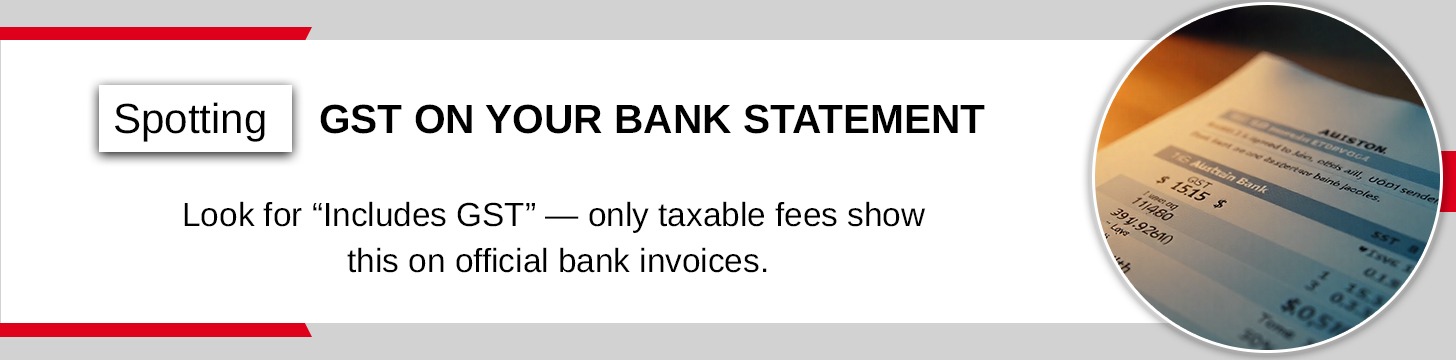
Understanding whether a bank fee includes Goods and Services Tax (GST) is super important for both individuals and businesses, especially those that need to sort out Business Activity Statements (BAS) or claim input tax credits.
Most banks are pretty clear about the GST components on their monthly or annual statements, but working out what they mean can be a bit tricky – it needs some attention to a few key details.
Where to Look for GST Information?
- Tax Invoices or Statements: Banks issue tax invoices when there is a service that includes GST.
- The fine print: Keep an eye out for words like “Includes GST” or “No GST applicable.” – that’s usually the giveaway.
- Business banking portals: Fee breakdowns usually have a GST column, but that depends on the bank.
- Annual Fee Reports: At the end of the financial year, banks do a summary of which fees are taxable and which aren’t.
| Description on Statement | GST Status | Interpretation |
| “Merchant Service Fee – Includes GST” | Taxable (10%) | Business can claim input tax credit |
| “Loan Establishment Fee – No GST” | Exempt | Financial supply, no GST charged |
| “ATM Fee – GST Not Applicable” | Exempt | Linked to deposit account, input-taxed service |
| “Audit Certificate Fee – GST 10%” | Taxable | Service-based fee subject to GST |
Why Does This Matters?
- Businesses can only claim GST credits on things that are clearly listed as taxable.
- If you get it wrong, it can lead to ATO penalties during audits.
- Keeping clear records means you end up with accurate financial records and stay compliant.
Let’s look at a practical example
- If a company gets a statement saying “Merchant Service Fee – $550 (Includes GST)”, they can claim $50 as an input tax credit.
- But if the same statement lists “Account Maintenance Fee – $20 (No GST)”, then no claim can be made.
International Transactions and GST
When dealing with international banking transactions, the GST treatment in Australia depends on a couple of things: whether the service provider is based in Australia and whether the transaction is considered a financial supply or not.
In most cases, overseas transaction fees are input-taxed, but certain administrative charges associated with cross-border payments might include GST.
How GST Applies to Overseas Transactions?
The ATO makes a distinction between financial services and non-financial services:
- Financial transactions, such as currency conversions or international wire transfers, are generally GST-free.
- Administrative services, like document handling, set-up fees or payment tracking, might include GST if the provider is located in Australia.
- If the bank or payment provider is overseas and not GST-registered, then no GST applies, even if you use it in Australia.
Some examples to keep in mind
- When an Australian business pays a $25 international transfer fee to its local bank, that fee is usually GST-free – it’s part of a financial supply.
- However, if the same bank charges an $11 courier or processing fee for handling SWIFT documents, GST might apply.
- Online payment gateways like PayPal Australia or Stripe Australia have to charge GST on their service fees, as they are registered entities under Australian GST law.
| Service Type | Provider Location | GST Status | Explanation |
| International Wire Transfer | Australia | No | Input-taxed financial supply |
| PayPal Processing Fee | Australia | Yes | Digital service subject to GST |
| Overseas Bank Transfer Fee | Non-resident bank | No | Supplier not GST-registered |
| SWIFT Document Handling | Australia | Yes | Administrative charge, not financial |
Key Takeaway
For international banking, where the service is provided and what service it is determines GST treatment.
- If it’s a financial service, it’s generally GST-free.
- If it’s an administrative or technology-based service and provided by an Australian-registered entity, then GST applies.
Impact of GST on Consumers and Small Businesses
The way banks deal with GST on bank fees has a big impact on just how consumers and small businesses manage their cash flow and what it costs them to be in compliance.
Although most financial services are not taxed on the GST bit, the indirect effects of GST can still be seen in how banks price their services, what they have to pay in operating costs and how complicated their tax returns are.
Impact on Consumers
For everyday folk, the fact that most bank fees are exempt from GST is a big plus. When no GST applies you don’t get a 10% extra whack on fees like keeping your account or getting cash out of the ATM. This helps keep essential financial services relatively affordable.
However, as consumers you can still get hit with indirect GST costs because banks just can’t claim back the GST on their own costs. So what happens is that banks just factor those costs into their standard fees and interest rates – which can add up.
Example
- A $5 account fee might well have an extra bit added on because the bank can’t claim the GST on the administrative costs they had to pay – even though you didn’t get charged any GST yourself.
Impact on Small Businesses
For small businesses, the way GST works on bank fees makes a big difference to cash flow and tax reporting. The key implications are –
- Businesses can only claim GST credits on the bits of their bank fees that are actually taxable – like if they’re a merchant and have to pay for services like payment processing.
- For the bits that can’t be taxed, like loan charges or account maintenance fees, businesses can’t get any GST credits which is a shame.
- Businesses need to separate out the bits of their bank bill that are GST and the bits that aren’t in their accounts and when they do their tax returns.
| Entity Type | Fee Example | GST Claimable | Effect |
| Consumer | Account-Keeping Fee | No | GST exempt, lower direct cost |
| Small Business | Merchant Service Fee | Yes | Claimable input tax credit |
| Small Business | Loan Establishment Fee | No | Input-taxed, cannot claim credit |
Future of GST and Financial Services in Australia

With the way the financial sector is moving – more digital, automated and connected to the world – GST and financial services in Australia are going to change.
Even though financial services have always been largely tax-free – well, that’s not necessarily a good thing in a world with all these new fintech platforms, crypto payments and AI driven financial advice.
Potential Policy Reforms
The Australian Treasury and Board of Taxation are always reviewing how GST works for financial services.
Future discussions may well focus on:
- Simplifying the rules on GST and financial services – just to save businesses and banks a bit of money on admin.
- Extending GST to include some of the digital financial products – because that’s just where the world is headed.
- Getting our GST rules more in line with what is happening elsewhere in the world – where some countries are starting to move to a partial tax model.
For instance, New Zealand has already introduced some new GST rules for financial intermediaries – and that might well influence policy here in Australia.
Digital Transformation and GST Complexity
The rise of digital wallets, payment gateways and Buy Now Pay Later (BNPL) platforms has made it a lot harder for the ATO to decide where GST fits.
These new systems are always a mix of financial transactions (which get taxed differently) and tech and administration costs (which are taxable).
As more and more people start to use digital banking – and by 2026 that’s going to be 95% of the population (Statista, 2025) – the ATO is going to need some pretty clear guidelines to make sure they’re getting it right and treating everyone fairly.
| Emerging Area | Likely GST Impact | Reason |
| Digital Wallet Services | Possible GST inclusion | Administrative and tech-driven service |
| BNPL Platforms | Mixed treatment | Financial and service elements combined |
| AI-Based Financial Advice | GST applicable | Considered consultancy or digital advice |
Key Takeaway
By 2030, we’ll likely see a shift in the way GST works for financial services in Australia – towards greater transparency, more digital inclusion and a system that is simpler and fairer for everyone.
The ATO’s job will be to find a balance between supporting innovation and making sure the system is fair – so that consumers and businesses both get a clear and consistent deal on GST.
Conclusion: Are Bank Fees GST-Free?
Yes -bank charges in Australia are generally GST-free because they’re considered input-taxed financial services under ATO rules. That includes fees like monthly account fees, ATM withdrawals and loan setup costs.
However, some service-based fees – like merchant or document processing charges – do attract GST. So, it’s worth noting that core banking fees are GST-free while admin fees have GST applied – take a look at your bank statement to confirm.
FAQs – Are Bank Charges GST-Free in Australia?
1. Are Bank Charges Subject to GST in Australia?
Most bank charges in Australia are GST-free – this is because they’re classed as financial supplies which are exempt from GST.
These are services all about money management – such as making or taking out deposits, or keeping an account up to date – and so aren’t subject to GST.
So, when you pay your monthly account fee or a withdrawal fee at an ATM, you don’t usually have to worry about GST being added.
But if a bank provides extra services like offering advice, brokerage or foreign exchange services, GST does kick in.
It’s always a good idea to have a look at your bank statement and make sure GST hasn’t been applied to any fee.
2. Why Are Most Bank Fees and Services GST-free?
It’s down to the fact that most bank fees don’t include GST because they’re all part of financial transactions, not standard goods or taxable services.
This stops banks getting hit with GST twice for the same transaction.
By treating financial services as input-taxed, customers don’t get landed with GST for everyday banking activities like saving, transferring or borrowing.
This keeps things pretty simple and stops double taxation.
But when a bank does provide a service that’s not strictly financial – like consultancy or document processing, for example – GST usually does apply.
3. Which Bank Fees Are GST-free?
Most everyday banking charges are GST-free – including:
- Fees for keeping a transaction or savings account up to date.
- Loan application fees or maintenance costs.
- ATM and EFTPOS withdrawal fees.
- Fees for cheque dishonour or direct debit rejection.
- Annual credit card charges.
These are all considered financial services.
However, if your bank offers something extra like safe deposit box rental, foreign draft services or special document certification, GST might be applied.
It really depends on what service they’re providing.
4. How Can Businesses Tell if GST Applies to Bank Fees?
Businesses can just check their bank statements or tax invoices to see if GST applies – if it does, it should be clear on the invoice as a 10% component of the total fee.
If there’s no GST line item, then the charge is GST-free.
As a general rule:
- It’s a good idea to separate GST-free expenses from taxable ones.
- Keep a clear record of bank-related transactions.
- Go over all bank-related expenses when you’re doing your BAS to make sure you’ve got everything right.
Classifying things properly will save you from mistakes and help you stay compliant.
5. Are International or Foreign Transaction Fees GST-free?
Yes, most international transaction fees are GST free too.
That’s because they are cross border financial activities like international transfers or overseas card payments.
These are outside the regular GST system in Australia.
But if your bank charges extra service fees for special processing or document handling, that part may be GSTable.
Read your bank’s fee breakdown to see how GST applies to different parts of international transactions.