







Australia’s corporate landscape is controlled by a few big players that not only drive the national economy but also the investment, property and digital-service ecosystems you and your readers interact with every day. Knowing who these “big-10” companies are is a useful filter for your verticals—whether it’s tracking institutional investment flows in property markets, analysing capital allocation in tech/IT or monitoring large-cap exposure in portfolio strategies.
Why Do the “biggest Companies” Matter?
- The total market cap of all listed domestic companies in Australia was around US $1.737 trillion in 2024.
- The biggest companies—especially the banks and resources companies—account for a disproportionate share of the national market-cap and therefore influence index behaviour, investor sentiment and capital availability for smaller companies (including in IT/web-services or property infrastructure).
- For property and investment themes: The big companies set the tone for credit availability, dividend flows, superannuation fund allocations and downstream supplier ecosystems (contractors, PropTech, digital agencies).
- For your web-design/IT vertical: Many of Australia’s biggest companies are big clients for digital transformation, venture funding and outsourcing—so knowing who they are helps you position your service offerings accordingly.
Snapshot of the Top-10 Largest Companies in Australia (by market cap)
Here are some of the largest companies in Australia today, giving a flavour of sectors and scale:
| Company | Market Cap* | Sector | Why notable |
| Commonwealth Bank of Australia (CBA) | ~ US $188 billion | Banking/Financials | Australia’s largest bank by market value; huge influence on consumer, business and institutional finance. |
| BHP Group Limited (BHP) | ~ US $147 billion | Resources/Mining | One of the world’s largest mining companies; minerals & commodities exposure link to global cycles that affect property/investment. |
| National Australia Bank (NAB) | ~ US $88 billion | Banking | Among the “big four” banks – important for commercial property finance, SME digital services, etc. |
| Westpac Banking Corporation (Westpac) | ~ US $86.6 billion | Banking | Long-established bank; also a major player in home mortgage finance, which links to your property/investment verticals. |
| Australia & New Zealand Banking Group (ANZ) | ~ US $72.4 billion | Banking | A strong regional bank, offering cross-border links (NZ, Asia) which helps contextualise offshore investment flows in your content. |
| Wesfarmers Limited | ~ US $64.9 billion | Conglomerate / Retail & Industrials | Broad-based business: retail (Bunnings, Kmart), industrials – useful for understanding retail property, supply-chain, and digital service demand. |
| CSL Limited | ~ US $57.0 billion | Biotechnology / Pharmaceuticals | A global innovator from Australia – shows how non-bank, non-resources companies reach large scale; relevant for tech/IT services vertical. |
| Macquarie Group Limited | ~ US $56.3 billion | Financial / Investment Banking | Plays a key role in infrastructure, asset-management, and alternate credit – connects with property, caravan finance and tech investment themes. |
| Goodman Group | ~ US $44.3 billion | Real-estate / Property Investment | Direct relevance to your property vertical: one of Australia’s largest property/industrial REIT-type vehicles. |
| Fortescue Metals Group | ~ US $29.6 billion | Mining / Iron-Ore | A smaller (top-10) player but emphasises the breadth of “big” companies beyond banking. |
Top 10 Biggest Companies in Australia 2025
1. Commonwealth Bank of Australia

Commonwealth Bank of Australia (CBA) is Australia’s largest publicly-listed company – and for good reason. Here’s why, followed by the latest numbers.
Why is CBA the Best?
- Scale and market share: CBA has a big chunk of Australia’s mortgage and deposit businesses, making it the leader in retail and business banking. For example, it writes around a quarter of Australia’s ~$2.2 trillion mortgage market.
- Strong performance: CBA has delivered strong net profit after tax (NPAT) and high payout ratios through economic ups and downs – it’s operationally resilient. For FY 2024 CBA reported a statutory NPAT of $9,394 million (down ~6% year-on-year) and a fully-franked dividend of $4.65 per share.
- Disciplined cost-income ratios: With total operating income of $27,174 million in FY 2024, CBA is generating strong revenue.
- Leading in digital banking and customer experience: By investing in technology and customer platforms, CBA has built customer loyalty and lower relative cost structures which supports margins and retention.
- Resilience through macro headwinds: Even when the economy is tough, CBA delivers returns – it shows it can manage credit risk and maintain margins. For example, it reported a FY2025 cash NPAT of ~$10.252 billion.
Selected Financial Metrics
Below is a summary table of recent key financials for CBA:
| Metric | Value | Notes |
| Total Operating Income (FY 2024) | $27,174 million | Shows core revenue generation capability |
| Net Profit After Tax (Statutory, FY 2024) | $9,394 million | Reflects profit attributable to shareholders |
| Earnings Per Share (Basic, FY 2024 – cash basis) | ~$5.87 per share (-rc) | EPS gives per-share profit insight |
| Dividend Per Share (Fully Franked, FY 2024) | $4.65 per share | Strong shareholder return via dividend |
Why These Numbers Matter
- With operating income over $27 billion, CBA can generate big revenue across many banking products – a hallmark of a top-tier bank.
- A net profit of ~$9.4 billion when profit fell shows the bank’s franchise strength and ability to absorb economic shocks and still deliver returns.
- EPS and dividend levels mean shareholders are being rewarded consistently – the dividend of $4.65 per share in FY 2024 is fully franked, so it’s attractive to many investors.
- The diversified business (retail, business, institutional banking, wealth, insurance) reduces reliance on any one segment – adds to stability and reinforces its “powerhouse” status.
- And its leadership in technology and customer-centric banking gives it a competitive edge in a market where digital experience matters.
CBA’s scale, profitability, operations, shareholder returns and digital leadership makes it Australia’s number one bank and the benchmark for “biggest company”. For your finance/investing audience, CBA is a case study on how a financial services business builds scale, maintains margins, diversifies across products and returns capital to shareholders.
2. BHP Group
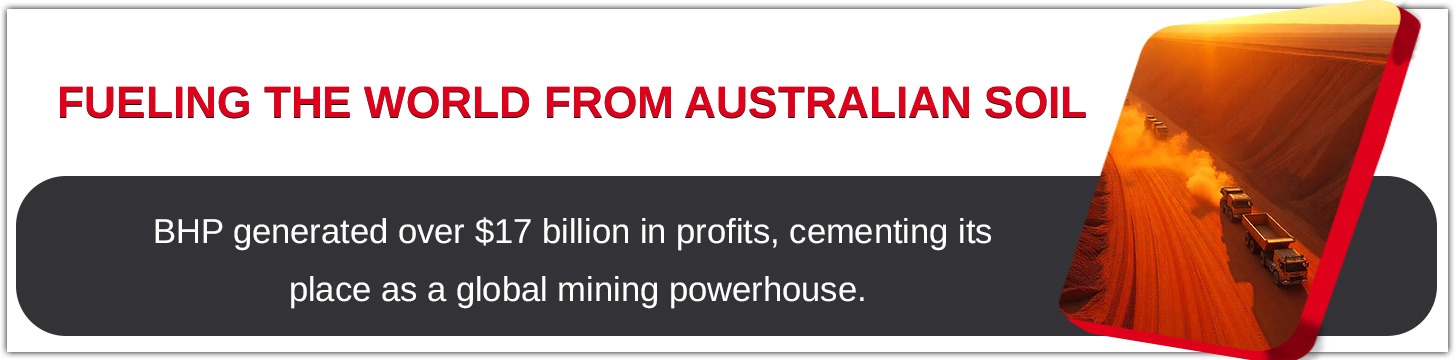
BHP Group (a name more commonly known as BHP) has earned a place at the very top of Australia’s business elite through a combination of its enormous scale in natural resources, a global footprint that stretches far and wide, and an unwavering commitment to operating with discipline.
It stands out for a number of very compelling reasons, each of which helps to explain why we’d describe it as “the Global Mining Titan Fueling Australia’s Resource Economy”
Why is BHP the Best in Class
- The sheer scale and reach of its global operations sets it apart: BHP operates – amongst other things – iron ore, copper, coal, potash and other resource assets all around the world, which gives it a really broad exposure to key commodity swings and shifts.
- Top-notch operational performance: In FY 2024 BHP brought in an operating profit of US $17.5 billion – a truly impressive sum.
- A sustained focus on growth in key commodities : With for example copper volumes up by 9% in FY 2024 – the second year in a row to see a rise.
- Leading the charge on cost : BHP’s Western Australia Iron Ore (WAIO) operations are the lowest-cost iron ore producers in the world, which is no mean feat.
- Delivering strong returns for its shareholders : In FY 2024 it paid out a final dividend of 74 cents per share, with a full-year payout ratio of around 53%
- Future-proofing its portfolio : BHP is ploughing a lot of money into investing in growth for copper and potash – two of the key commodities that will drive the shift to cleaner energy and fertilisers.
Selected Financial Metrics
Below is a summary of some of BHP’s recent key financials (for year ended 30 June 2024).
| Metric | Value | Notes |
| Total Revenue | ~US $55.65 billion (≈$82.1 billion) | Top-line scale of business |
| Profit from operations | US $17.5 billion | Reflects operational strength |
| Underlying attributable profit | US $13.7 billion (≈2 % higher year-on-year) | Profit-after-one-off basis |
| Dividend per share (full year) | US $1.46 per share (includes US $0.74 final) | Shows shareholder return |
| Payout ratio | Approx. 53 % | Indicates return of earnings to shareholders |
Why These Figures Matter
- Revenue of ~US $55.65 billion confirms that BHP operates at a truly massive scale, putting it amongst the major resource companies in Australia – and the world.
- Profit from operations and underlying profit show that BHP doesn’t just rely on its size – it’s also executing really well, sustaining its margins even in a highly volatile commodity market.
- The dividend of US $1.46 per share and 53 % payout ratio show that BHP is striking a good balance between reinvesting and returning to shareholders – a hallmark of a top-class mining company.
- Its cost leadership (for example the lowest-cost iron ore production) and sustained growth in high-demand commodities (like copper) give it structural advantages, not just cyclical benefits.
- With global demand for minerals like copper, potash and iron ore expected to stay strong (especially as the world builds more infrastructure, switches to cleaner energy and urbanises), BHP’s portfolio positions it well for the long term – which all adds to its “titan” status.
To cut a long story short, BHP’s combination of size, global diversified commodity exposure, cost-leadership, consistent operational performance and shareholder return make it a clear leader amongst Australia’s biggest companies.
For finance and investing professionals, BHP serves as a prime example of how a resources-based company can dominate both at home and abroad – and also adapt for future growth beyond traditional commodity cycles.
3. CSL Limited

CSL Limited stands out through its focus on cutting-edge therapies, global reach, strong growth and innovation in biotechnology.
It’s one of Australia’s top companies not just for size but for its position in the global healthcare-biotech sector.
Why is CSL Best in Class?
- Innovation-backed global business model: CSL’s businesses cover lifesaving therapies (CSL Behring), vaccines (CSL Seqirus) and iron-deficiency/nephrology treatments (CSL Vifor) – giving it broad exposure across major healthcare segments.
- Strong revenue and profit growth: For the 12 months ended 30 June 2024, CSL reported total operating revenue of US $14.80 billion, up ~11% from the prior year.
- High net profit after tax (NPAT) and earnings per share (EPS): NPAT was US $2.64 billion in FY2024, with basic EPS of US $5.47 (up from US $4.55 in the prior year).
- Good shareholder returns: Full-year dividend was US $2.64 per share for FY2024 (final US$1.45 per share) – a decent payout for shareholders.
- Leadership in high-demand medical portfolios: For example, immunoglobulin (Ig) product sales grew ~20% in FY2024, driven by strong patient demand globally.
- Global footprint and resilience: CSL operates in over 100 countries, employs over 32 000 people and is headquartered in Melbourne but serves global markets.
Selected Financial Metrics
Here is a table summarising key metrics for FY2024:
| Metric | Value | Note |
| Total Operating Revenue | US $14.80 billion | Represents global operations, up ~11% year-on-year |
| Net Profit After Tax (NPAT) | US $2.64 billion | Profit attributable to CSL Limited shareholders |
| Basic Earnings Per Share (EPS) | US $5.47 | Calculated on net profit attributable to shareholders |
| Dividend Per Share | US $2.64 full-year (final US $1.45) | Shows company returning cash to shareholders |
Why These Numbers Matter
- The 11% revenue growth shows CSL can grow in competitive biotech markets – impressive given the regulatory, development-cycle and R&D-intensity headwinds in this sector.
- NPAT of US $2.64 billion and EPS of US $5.47 means the growth is not just top-line, but profitable and for shareholders.
- The dividend of US $2.64 per share means the company is committed to paying out to shareholders – which for a biotech company (often re-investing heavily into R&D) is a good balance between growth and return.
- Growth in key product lines (e.g. immunoglobulin sales up ~20%) shows CSL is executing on its innovation pipeline, meeting patient demand and strengthening its market position.* Global footprint and leadership in plasma-derived therapies, vaccines and specialty pharma gives it a structural moat — no single geography or product to rely on.
In summary, CSL Limited’s innovation-backed business, diversified therapeutics, global reach, profit growth and shareholder returns makes it one of the best Australian companies.
For your finance/investing audience, CSL is a great example of how a healthcare/biotech company can go global, grow profitably, invest in growth and deliver to shareholders — one of the top Australian large caps.
4. National Australia Bank

National Australia Bank (NAB) is a major player in Australia’s commercial and retail banking landscape — serving millions of customers from small businesses to large corporations.
It stands out for several reasons, hence the tag “the Trusted Financial Partner Driving Business Growth.”
Why is NAB the Best in Class?
- Widespread business banking footprint: NAB lent $48 billion to businesses in FY 2024, backing growth and showing its commitment to business & private banking.
- Resilience in tough times: NAB reported statutory net profit after tax of $6.96 billion in FY 2024, down 6.1 % on the prior year — so it’s still profitable despite the headwinds.
- Investing in growth areas: NAB grew deposits in its Business & Private Banking division by 7% in the year, so it’s focused on scaling this segment.
- Strong regulatory and capital position: NAB had a CET1 capital ratio of 12.35% at year-end which is a solid capital base and prudent risk management.
- Diversified offering: As one of Australia’s “Big Four” banks, NAB offers retail, business, institutional banking and wealth services — so it’s across the customer spectrum and not reliant on one segment.
Selected Financial Metrics
Here is a summary of the key financials for FY 2024:
| Metric | Value | Notes |
| Total Income / Revenue | ~$20.65 billion (Revenue) | Top-line scale across the bank’s businesses |
| Net Profit After Tax | $6.96 billion (Statutory) | Profit attributable to shareholders |
| Cash Earnings | ~$7.10 billion (down 8.1 %) | ‘Cash’ earnings measure commonly used for banks |
| Dividend per Share | Final fully-franked dividend of 85 cents per share | Reflects shareholder return |
Why These Numbers Matter
- A revenue of ~$20 billion means NAB is a big business — essential for any bank that wants to be a top-tier player.
- Net profit of nearly $7 billion (even down from the prior year) means the bank is still a major profit-maker — important in the Australian banking landscape.* The cash earnings and the dividend being maintained shows NAB is balancing growth, profit and shareholder returns — not sacrificing one for the other.
- The 85 cents per share (fully franked) dividend means shareholders are getting a decent return — which is a key feature of a big, trusted financial institution.
- The growth in business banking deposits and loans shows NAB is strategically strong in supporting corporate clients and is a partner in business growth not just a retail lender.
In summary, NAB’s wide footprint in commercial and retail banking, strong capital, scale and tangible support for business growth makes it a big player in the Australian financial landscape.
For your finance/investing audience, NAB is a great example of how a diversified bank can support everyday consumers and business clients while delivering shareholder returns and managing risk — so it’s a good one to include among Australia’s largest companies.
5. Westpac Banking Corporation

Westpac Banking Corporation (Westpac) combines a rich history and a digital future — one of Australia’s biggest and most robust financial institutions.
Founded in 1817 (as the Bank of New South Wales) and merged into Westpac in 1982, the bank has more than two centuries of banking experience.
Why Westpac is Best in Class?
- Legacy and transformation: As Australia’s oldest bank, Westpac uses deep market knowledge, while investing heavily in digital banking platforms and customer service to stay ahead.
- Strong financials and scale: FY 2024 revenue of $21.76 billion.
- Profitability endures: Net profit after tax (statutory) FY 2024 $6.99 billion, down 3% on FY 2023 — a tough environment.
- Earnings per share and dividend commitment: Basic EPS from continuing operations FY 2024 $2.009 per share.
- And Westpac announced a full year ordinary dividend of $1.51 per share (fully franked).
- Digital and customer experience focus: Improving customer service, growing consumer and business banking, and maintaining a strong capital base — gives Westpac strategic strength in the market.
Selected Financial Metrics
Here’s a summary of key financials for Westpac in FY 2024:
| Metric | Value | Notes |
| Revenue / Total Income | ~$21.76 billion | Reflects scale of operations in FY 2024 |
| Net Profit After Tax (Statutory) | $6.99 billion | Down ~3% on previous year |
| Basic Earnings Per Share (Continuing) | $2.009 | For the full year ended Sept 30 2024 |
| Dividend Per Share (Ordinary, full year) | $1.51 per share (fully-franked) | Return to shareholders. |
Why These Numbers Matter
- $21.8 billion revenue shows Westpac is very big, covering retail, commercial, institutional and wealth banking services.
- $7 billion net profit — down slightly — is strong and Westpac is a big profit generator in Australian banking.
- $2.009 EPS is per-share profit, useful for investors to value on a per-share basis.
- $1.51 dividend per share shows Westpac’s commitment to returning cash to shareholders, and its reputation for being a reliable income investment.
- Westpac’s heritage, digital innovation, customer service and capital return is the “Oldest Bank with a Modern Digital Edge” concept — one of Australia’s biggest, most enduring and evolving banks.
In summary, Westpac’s longevity, scale, financial performance, shareholder returns and digital transformation makes it one of the top companies in Australia.
For your finance/investing audience, Westpac is a strong case: a big bank that bridges traditional and modern — a part of the Australian corporate landscape and one of the biggest companies in Australia.
6. Australia and New Zealand Banking Group

The ANZ Banking Group – a standout in Australia’s major banking landscape – holds a singular position, blending regional presence with a strategic banking product reach that spans the country, New Zealand, and beyond.
It earns its title – “Regional Banking Leader with Trans-Tasman Strength” – by cleverly combining geographic reach, a diverse range of services, and robust institutional operations.
Why ANZ sets itself apart
- Its dual-country footprint has ANZ serving both Australian and New Zealand markets, giving it access to trade flows, institutional banking and corporate lending right across the Tasman.
- ANZ’s revenue mix is highly diversified across retail, commercial and institutional banking – Australia Retail makes up about 29%, Australia Commercial 17%, and Institutional a healthy 34% as of FY 2024.
- A look back at ANZ’s recent full-year performance for the year ended September 2024 shows a statutory profit after tax of $6,535 million – a bit down 8% on the previous year – which still highlights both the scale and resilience of the business in a competitive environment.
- ANZ’s board has shown a strong commitment to shareholder returns by declaring a final dividend of $0.83 per share (70% franked) for FY 2024 – which brings the full-year dividend to approximately $1.66 per share.
- ANZ has also been investing heavily in its digital banking platform (think “ANZ Plus”) which has grown to around 700,000 customers and $14 billion in deposits in the half-year period.
- ANZ’s capital and prudential metrics remain strong with a Common Equity Tier 1 (CET1) ratio of 12.2% for FY 2024 – supporting its status as a major regulated banking group.
Selected Financial Metrics
Here’s a summary of key metrics for ANZ in FY 2024 (year ended 30 Sept 2024):
| Metric | Value | Notes |
| Total Operating Income / Revenue | $20,547 million (≈ $20.55 billion) | Top-line revenue for FY 2024 |
| Net Profit After Tax (Statutory) | $6,535 million | Profit attributable to shareholders |
| Earnings Per Share (Basic) | $2.243 (224.3 cents) | EPS for full year |
| Dividend Per Share (Full-Year) | $1.66 per share | Includes final dividend of $0.83 |
Why these numbers are worth paying attention to
- When revenue tops $20 billion, as it does at ANZ, you’ve got a real contender on your hands – and it solidifies the bank’s position among the largest in Australia and the region.
- Even though profit was down a bit year-on-year, a net profit after tax of $6.535 billion still shows ANZ is able to generate significant earnings despite all the challenges it faces – and that’s a key mark of a top-performing company.
- EPS of around $2.24 per share gives investors a clear view of the bank’s profitability, enabling them to compare how it’s performing against its peers and make informed decisions about value.
- The fact that ANZ is still able to pay out a full-year dividend of $1.66 per share despite profit pressure shows that the bank remains committed to returning cash to shareholders – which is exactly what income-focused investors are looking for.
- The fact that ANZ is investing so heavily in digital platforms (that’s 700,000 customers and $14 billion in deposits for you) suggests a company with real future ambitions – not just a bank that’s stuck in the past.
- A strong capital ratio (12.2% CET1) is essential for any bank to worry about, but ANZ is able to tick this box with ease – and that’s another tick in the box for its status as a reliable major bank.
In a nutshell, ANZ’s combination of a strong geographical presence (Australia and New Zealand), a diversified range of services (retail, commercial, institutional), scale, meaningful profitability, and shareholder returns make it a standout in Australia’s largest companies.
For investors and finance enthusiasts, ANZ offers a great case study in how a major banking group can successfully blend regional scale, digital investment and shareholder discipline – making it a core candidate on any list of Australia’s largest companies.
7. Macquarie Group Limited

Macquarie Group: The investment powerhouse carving out a special place in the Australian corporate landscape
It’s no surprise that Macquarie has earned the title of “The Global Investment Innovator Powering Infrastructure and Green Finance”, thanks to its leadership in asset management, global markets and sustainable finance.
Why does Macquarie stand out as the best in its class?
- Its world-class business model is a perfect blend of diversification & scale: With a footprint in over 34 markets worldwide, Macquarie operates in asset management, banking & financial services, commodity & global markets and capital & investment operations.
- Despite headwinds, Macquarie still punches above its weight when it comes to profitability: FY 2024’s net operating income of $16.887 billion was a respectable $16.887 billion, down 12% on the prior year.
- Net profit was down, but still a big number: FY 2024’s net profit after tax was $3.522 billion, down 32% compared with the previous year – but still a very respectable profit in the Australian corporate context.
- Earnings per Share (EPS) was a healthy $9.17: And dividend per share was $6.40 per share – a payout that shows Macquarie is balancing growth with shareholder returns.
- Assets under management are eye-watering: Around $938.3 billion in FY 2024, evidence that Macquarie has scale in the global investment market.
- And then there’s the infrastructure and renewable energy investments – Big wins that are giving Macquarie structural strengths beyond the banking and mining sectors.
Selected Financial Metrics
| Metric | Value | Notes |
| Net Operating Income (FY 2024) | ~$16.887 billion | Broad revenue across segments |
| Net Profit After Tax (attributable) | ~$3.522 billion | Large profit base despite decline |
| Earnings Per Share (EPS) | ~$9.17 per share | Per-share measure for investors |
| Dividend Per Share (Full Year) | ~$6.40 per share | Shareholder return payout |
So why do these figures really matter?
- $16.9 billion operating income is a big league number, putting Macquarie on the same level as other major Australian corporates.
- $3.5 billion net profit shows you that Macquarie is still a major player despite the tough market.
- $9.17 EPS shows strong per-share earnings – useful for investors who care about valuation and return potential.
- $6.40 dividend is a solid return to shareholders, one that shows Macquarie is committed to both growth and shareholder returns.
- Assets under management of $938 billion puts Macquarie in the big league of global fund managers – and makes its ‘investment innovator’ status well-deserved.
In short, Macquarie’s combination of global reach, diversified operations, asset-management scale, strong earnings base and meaningful shareholder returns make it a top-ranked company among Australia’s biggest corporations.
For finance and investing enthusiasts, Macquarie’s story is a compelling case study in how a big Australian company has used its global reach and diversification to become a major player in the world of asset management, infrastructure finance and sustainable finance – making it a standout in any list of ‘top 10 biggest companies in Australia’.
8. Wesfarmers Limited

Wesfarmers’ unique feature: It owns and operates some of Australia’s most well known retail and industrial brands (Bunnings, Kmart and Officeworks) and combines this with strong industrial/commodities arms — giving it a broad base of operations to ride out economic cycles.
Why Wesfarmers is Best in Class
- Diversified portfolio spreads risk and opportunity across sectors — retail, industrials, resources, chemicals and more — so not reliant on one segment.
- Retail divisions executed well: Bunnings and Kmart responded to cost of living pressures by offering value and broadened product ranges and kept growth going in a tough environment.
- Statutory net profit after tax (NPAT) of $2,557 million for the year ended 30 June 2024, up 3.7 % on the prior year.
- Revenue (total income) of $44,189 million (≈ $44.19 billion) for the same period, up ~1.5 % year on year.
- Emphasises productivity and cost control so growth in profit despite low revenue growth shows quality of execution.
Selected Financial Metrics
Here are the key metrics for FY 2024 (year ended 30 June 2024):
| Metric | Value | Notes |
| Total Revenue / Total Income | ~$44,189 million | Up ~1.5% year-on-year. |
| Net Profit After Tax (Statutory) | $2,557 million | Up ~3.7% from prior year. |
| Basic Earnings Per Share (EPS) | ~225.7 cents per share (≈$2.257) | Up ~3.6% year-on-year. |
| Dividend Per Share (Final) | $1.07 per share (final) | Up from prior year. |
Why These Figures Matter
- Revenue of ~$44.19 billion makes Wesfarmers a big company in the Australian corporate landscape — like a top company.
- 3.7% NPAT growth shows the company is not just big but growing earnings — important for a top company.
- EPS growth (~3.6%) means per share earnings are growing — important for investors who care about value on a per share basis rather than just total earnings.
- Dividend of $1.07 per share means shareholders are getting decent returns — like a mature company delivering value back to owners.
- Diversified (retail + industrial) gives Wesfarmers structural resilience: when one segment is weak (e.g. construction downturn affecting hardware) others (like value retail) can pick up the slack
- Company focused on improving productivity and value for customers in a tough consumer environment shows strategic responsiveness — a top company trait rather than just a big one.
Wesfarmers has scale, diversified operations across major Australian consumer and industrial sectors, profit growth and shareholder returns.
For your finance/investing audience, Wesfarmers is a great example of a conglomerate:
- Owns everyday facing brands (Bunnings, Kmart) to capture consumer spending under pressure,
- Has industrial/resource exposure to give it cyclicality,
- Can grow profit even under low revenue growth and
- Returns value to shareholders through the tough times.
If you like I can expand the 9th headline (Woolworths Group) to 300 words with the same format and metrics.
9. Woolworths Group

Woolworths Group is “The Retail Superpower Shaping Australia’s Consumer Economy” because of its grocery footprint, digital growth, customer loyalty programs and ability to navigate tougher consumer conditions while maintaining scale.
Why is Woolworths Best in Class?
- Market leading presence in Australian food retail: Australian Food division normalised sales growth of ~3.7% to ~$51 billion in FY 2024.
- Strong digital and e-commerce performance: WooliesX grew ~19.8% normalised sales in FY 2024, contributing to food division growth.
- Scale and resilience: Group sales (normalised) ~$67.9 billion in FY 2024, up ~3.7% year on year.
- Focus on value and customer experience: Average food prices in Australia down 0.2% (Q3) and 0.6% (Q4) in H2 FY 2024 as they responded to inflation and consumer cost pressure.
- Balanced approach across channels: Reinforcement of Everyday Rewards loyalty program, analytics platform (wiq) and retail media business (Cartology) shows they are investing beyond bricks and mortar.
Selected Financial Metrics
Here are key metrics for FY 2024 (year ended 30 June 2024) for Woolworths Group:
| Metric | Value | Notes |
| Total Group Sales / Revenue | ~$67.9 billion | Normalised growth of ~3.7%. |
| Net Profit After Tax (ex-significant) | ~$1.71 billion | Excluding major impairments. |
| Earnings Per Share (Basic) | ~140.3 cents per share (~$1.403) | EPS after items. |
| Dividend Per Share (Final & Special) | Final dividend: 57 cents, special: 40 cents ⇒ Total ~97 cents per share | Fully franked. |
Why These Numbers Matter
- ~$67.9 billion in revenue shows the enormity of Woolworths’ business, making them one of Australia’s largest companies by volume and reach.
- NPAT of ~$1.71 billion (excluding one-off items) means even with headwinds (consumer cost pressure, inflation, trading softness) the business is still profitable at scale.
- EPS of ~140.3 cents per share is the per-share profitability metric investors use to compare companies; Woolworths is still delivering returns on a per-share basis.
- A dividend of ~97 cents per share (including special dividend) is a strong signal of shareholder return – especially in a consumer facing business under margin pressure.
- Investing in digital channels and loyalty programs shows Woolworths is preparing for the future retail environment (omnichannel, data driven, value led) not just relying on old stores.
- Responding to consumer price pressure (dropped average food prices in H2) shows strategic agility – an important trait when ranking big companies not just by size but by quality.
In summary, Woolworths Group’s market leading position in Australian food retail, scale, profitability despite margin pressure, meaningful shareholder returns and future focused investment in digital and loyalty platforms makes them a standout among the biggest companies in Australia.
For your finance/investing audience, Woolworths is a great case study of how a big retail business responds to cost of living pressure, invests for the future, stays relevant to the consumer and delivers shareholder value – so they must be in the “top 10 biggest companies in Australia” list.
10. Telstra Corporation

Telstra Corporation stands out as the telecommunications giant of Australia, earning the description “The Telecommunications Trailblazer Connecting Modern Australia” thanks to its massive network, mobile leadership and pivotal role in the country’s digital infrastructure.
What makes Telstra stand out
- Dominant Network Infrastructure: Telstra remains the biggest player in Australian telcos, with a massive lead in mobile subscribers, fixed lines and broadband services – it’s this kind of base that allows Australians to live and work as they do.
- Strong Mobile Business Momentum: Last year in FY 2024 mobile services revenue went up by 5.6% and they picked up over 560,000 new mobile customers – which shows they can still win in a super competitive environment.
- Scale of operations with a huge bottom-line: In the 2024 financial year Telstra reported a total income (excluding finance income) of $23.5 billion, putting into perspective just how big their footprint is.
- Profitability and shareholder returns: Despite a declared Net Profit After Tax (NPAT) of $1.8 billion (down ~13%) in FY24, Telstra’s underlying profits actually rose ~7.5% to $2.3 billion – which shows the business’s real strength despite tough trading conditions.
- Giving back to shareholders – dividend and capital management: The total dividend paid out for FY 2024 was 18c per share (all fully franked) – that’s a 5.9% increase on the year before, and shows a real commitment to shareholder value.
- Future-proofing: Telstra’s ‘T25’ strategy focusses on upgrading their network (5G, fibre), cutting costs and getting more digital services on stream to keep them relevant for the long term.
Key Financial Metrics for 2024
Here’s a summary of key metrics for FY 2024 (year ended 30 June 2024):
| Metric | Value | Notes |
| Total Income (excluding finance) | $23.5 billion | Shows scale of operations. |
| Net Profit After Tax (NPAT) | $1.8 billion (reported) | Declined ~13% but underlying stronger. |
| Underlying NPAT | $2.3 billion | Underlying basis, up ~7.5%. |
| Dividend Per Share | $0.18 per share (18 c) | Fully franked, +5.9% growth. |
Why these figures are important
- A top-line of $23.5 billion means Telstra is up there with the biggest companies in Australia – that’s a large company status.
- Despite the reported NPAT falling, the real story is that the underlying profits actually rose ~7.5% – which is a pretty good result in tough trading conditions.
- A dividend of 18c per share shows that Telstra is not just investing in infrastructure, but also giving back to shareholders, which is a key factor in being considered one of the best.
- The mobile business is still growing – that’s a key part of their strategy and it shows they can adapt to the changing world.
- And all this is underpinned by a commitment to leading the way in 5G, fibre and other next-gen technologies – all part of their ‘T25’ plan to stay ahead.
So there you have it – Telstra is a standout company in Australia thanks to their massive scale, mobile momentum, shareholder returns and forward-thinking strategy.
For our finance/investing audience, Telstra provides a great example of how a big infrastructure company like this can dominate their category, keep up with the changing times and still deliver the goods for shareholders.
FAQs – Biggest Companies in Australia
1. Who are the biggest companies in Australia and how are they ranked?
Australia’s biggest companies are ranked by market capitalisation, revenue and profit.
BHP Group, Commonwealth Bank, CSL Limited and Westpac always top the list due to their dominance in mining, finance and healthcare.
These companies shape the Australian economy, employment, exports and GDP growth.
They are the engine room of the Australian business landscape.
2. Which sectors are the biggest?
Mining and banking are the biggest sectors.
Mining giants BHP, Rio Tinto and Fortescue Metals Group make billions from resource exports, especially iron ore and coal.
Financial institutions Commonwealth Bank, Westpac, ANZ and NAB anchor the economy through retail and commercial lending.
Together they make up a big chunk of Australia’s corporate value and contribute to national growth.
3. How do Australian companies perform globally?
Many of Australia’s biggest companies operate internationally.
CSL Limited for example earns most of its revenue offshore through biotechnology and healthcare innovation.
BHP and Rio Tinto are major suppliers to China, Japan and India so they have global relevance.
This international reach helps Australian companies stay competitive and financially strong even during domestic economic challenges.
4. What makes these companies financially strong?
The top Australian companies are strong because of diversification, consistent cash flow and strong dividends.
They combine innovation with stability – banks invest in digital technology, mining companies focus on sustainability and global supply.
For example high earnings per share and steady dividends make them attractive to local and international investors.
They are financially robust and have long term growth potential.
5. How do the biggest companies impact the Australian economy and workforce?
These companies are the pillars of the Australian economy, contributing to employment, taxes and superannuation.
They provide stable jobs across multiple industries – finance, energy, technology and logistics.
By supporting infrastructure and community programs they strengthen Australia’s social and economic fabric.
In short they build profits and power the nation’s progress and prosperity.