






When Australian investors look at building a diversified portfolio, two fundamental structures emerge: managed funds and index funds. While both allow pooling of capital and access to professional management, their philosophies, cost structures, performance records and suitability for different types of investors differ greatly. In this piece we’ll compare the two in the Australian context, provide some stats and help you frame how they fit into your investing framework.
What are the two fund types?
Managed funds (also called actively managed funds) are investment vehicles where a fund manager (or team) selects individual securities (shares, bonds, other assets) to outperform a benchmark or achieve a specific investment objective. The manager does research, forecasting and active decision making.
Index funds, on the other hand, are passive: they aim to replicate (or very closely track) a defined market index (e.g. the S&P/ASX 200 in Australia) by holding the same (or very similar) portfolio of securities. The goal is not to beat the market but to match it, often at a lower cost. For a general primer see the Vanguard material.
In the Australian market many managed funds are actively managed; many index funds are passive. It’s also possible for a managed fund to be index-based (i.e. passive) or for an index-based fund to be listed on the stock exchange (through an ETF structure) or unlisted. For background on vehicles in Australia see ETFs vs managed funds.
Key differences between Managed and Index funds in structure & cost

From an investor’s perspective the differences between managed vs index funds come down to a few practical attributes:
- Cost/Fees: Active managed funds have higher management fees (and may have performance fees) because of the research and active portfolio management involved. Index funds since they just track an index often have much lower expense ratios.
- Transparency & turnover: Index funds have lower turnover (fewer trades) because the portfolio just mirrors an index, which in turn can mean lower transaction costs, fewer capital-gains events and more predictability. Managed funds may trade more frequently and hence incur higher internal costs, tax consequences or tracking risk relative to a benchmark.
- Performance objective: For a managed fund the objective is often to beat the benchmark (net of fees). For an index fund the objective is to match the benchmark (net of minimal fees) and provide broad market exposure.
- Access & minimums: In Australia unlisted managed funds may require higher minimums or access through financial advisers or platforms; index funds and ETFs often have lower entry points and easier access for self-directed retail investors.
- Liquidity: Depending on the vehicle some managed funds may have daily pricing but slower settlement; index funds (especially via ETFs) may have intraday liquidity (if listed) and full transparency of holdings.
Performance & industry statistics (Australia)
Here are some meaningful data points specific to Australia that put some much needed context around how managed funds vs index funds have tracked over time.
- According to the latest data out of the Australian Bureau of Statistics (ABS) in their “Managed Funds, Australia” release, as of late 2023, the total assets under management in the Australian managed funds sector were roughly $4.751.5 billion, with a 3.9% increase in that particular quarter.
- When it comes to performance in the active (managed) funds space – one dataset shows that in the Australian equities section, a whopping 77% of managed funds failed to beat their benchmark over a single year; and over a 15 year horizon under-performance rises to around 85%.
- Now, let’s take a look back at some earlier data from a “SPIVA” style scorecard – it shows that in Australia, a massive 80.8% of those equity general funds failed to beat the S&P/ASX200 over a five year stretch.
- Which is a pretty big deal, considering this Persistence Scorecard from 2022 found that only about 6.25% of Australian equity funds that were sitting pretty in the top quartile at the end of 2021 were still there a year later.
Active Expertise in Motion – How Managed Funds Work in Australia

Managed funds operate with the guidance of seasoned fund managers who try to outperform benchmarks like the S&P/ASX200 by actively selecting which assets to invest in.
These funds pool cash from multiple investors to give people a chance to get diversified exposure to equities, bonds and property assets, all in one go.
Roughly $4.6 trillion in assets under management – that’s the massive footprint of managed funds in Australia, according to the AFR in 2025.
Now, unlike passive funds, managed funds rely pretty heavily on human know-how, research and timing. Fund managers use all sorts of inputs – macroeconomic analysis, sector rotation strategies, valuation models – to identify stocks or emerging growth opportunities that are undervalued and ready for a boost.
But, as you might expect, this active approach comes at a price. Your typical Management Expense Ratios are in the range of 1-2% – which is a lot more than the less than 0.30% you’d pay for an index fund. And over time, those extra fees can really start to erode returns, especially if markets are just sitting there doing nothing.
Example
Between 2014 and 2024, SPIVA Australia reported that 78% of active Australian equity funds underperformed their benchmarks over a full decade. That just highlights how hard it can be to consistently outperform the market, even for experienced fund managers.
Still, managed funds do have their moments – they can be useful in volatile markets or in special areas like resources, small-caps or ESG portfolios where a skilled manager can spot opportunities the broader market’s missing and really make some money.
Passive Precision – What Makes Index Funds a Simpler, Smarter Option

Index funds follow a passive investment strategy, designed to replicate the performance of a market benchmark such as the S&P/ASX 200 or MSCI World Index. Instead of relying on fund managers to pick stocks, these funds automatically mirror the index’s composition, reducing human bias and trading frequency.
Because of this structure, index funds are much cheaper. According to Morningstar Australia (2025), the average Management Expense Ratio (MER) for Australian index funds is around 0.20%, compared to 1.2% for active managed funds. This difference compounds over time—saving investors thousands in fees.
Example:
An investor putting $50,000 in an index fund with a 0.20% fee could save over $25,000 in costs after 20 years compared to an active fund charging 1.5%, assuming similar market returns.
Other benefits include:
- Transparency: You always know which companies you own.
- Diversification: Exposure to hundreds of stocks in one investment.
- Tax Efficiency: Fewer trades mean fewer taxable events.
In Australia, providers such as Vanguard, BetaShares, and iShares dominate the market, managing billions in index-based ETFs and funds.
Their low-cost, long-term performance has made index investing a cornerstone of modern Australian wealth strategies.
Managed vs Index Funds at a Glance – Head-to-Head Comparison
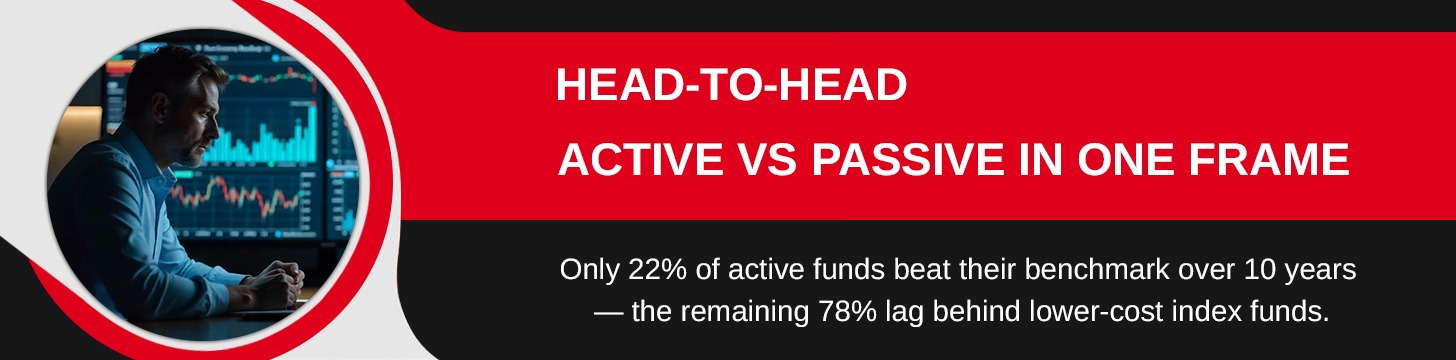
When comparing managed funds and index funds, the biggest differences are in management style, cost, performance consistency and transparency. Reserve your investor needs but their approaches and outcomes often diverge sharply.
Managed funds rely on active decision-making by fund managers who try to beat the market. Index funds follow a passive strategy, simply tracking a chosen benchmark like the S&P/ASX 200 or ASX 300.
This structural difference affects fees, returns and long-term performance.
Here’s a quick comparison:
| Feature | Managed Funds | Index Funds |
| Management Style | Active (human-driven) | Passive (index-tracking) |
| Average MER | 1% – 2% | 0.05% – 0.30% |
| Performance (10-year) | 22% beat benchmark | 78% lag benchmark (SPIVA, 2024) |
| Transparency | Low – decisions not disclosed | High – holdings public |
| Tax Efficiency | Lower (frequent trading) | Higher (less turnover) |
Reasons for the difference:
- Fees: Active management costs more because of research and trading.
- Consistency: Over long periods passive funds often outperform because of compounding fee savings.
- Transparency: Index funds disclose daily, managed funds quarterly.
So index funds are for cost-conscious, long-term investors, managed funds for tactical, high-conviction strategies.
The Fee Factor – Why Costs Matter More Than You Think
Investment fees may appear small at first glance but over time they add up to have a really profound impact on total returns. In Australia, managed funds generally charge between 1% and 2% per year, while index funds average around only 0.20%.
This difference may not seem like a lot, but spread out over decades it can really start to erode a large chunk of an investor’s wealth.
Example
If you put $50,000 into an investment earning a 7% annual return over 20 years:
- A managed fund with a 1.5% fee would likely end up being worth about $135,000
- An index fund with a 0.2% fee would likely grow to around $185,000
- And the difference here is a whopping $50,000 – just because of fees
These costs, known as the Management Expense Ratio (MER), cover things like fund management, research, administration, and marketing. But research from Morningstar Australia (based on data from 2025) shows that lower-cost funds generally outperform the higher-cost ones – across almost every type of investment.
Why do costs really matter?
- First and foremost, fees reduce the amount of money that earns returns – which means your investment growth is slowed.
- Second, in markets like Australia where the rules of the game are pretty well understood, higher fees don’t usually translate to higher returns.
- And third, lower-cost funds encourage people to hold onto their investments for the long haul – rather than constantly selling and buying which can lead to some pretty expensive mistakes.
For most Australians, the best way to get better investment outcomes is to keep a close eye on fees and try to keep them as low as possible.
The Performance Reality – What Australian Data Says About It

Performance is where the real difference between managed and index funds shows up. Despite all the skill and knowledge behind active managers, long-term data consistently shows that most of them can’t beat their benchmark after taking fees into account.
According to the SPIVA Australia 2024 Scorecard, over 80% of actively managed Australian equity funds ended up performing worse than the S&P/ASX 200 index over a 10-year period. And it gets even worse when you look at global and bond funds – where more than 85% of active funds failed to beat the benchmark.
Reasons behind this trend
- First and foremost, high fees can eat up most of your returns.
- Second, markets like Australia are well-researched and efficient – which makes it hard to find consistent mispricing.
- And third, people tend to trade too much which can lead to some pretty high transaction costs and tax liabilities.
Example
Over the 2020-2024 period, while the ASX 200 delivered an average annualised return of 7.5%, most active equity funds only managed 6.3% after fees, whereas index funds pretty closely matched the benchmark at around 7.3% to 7.4%.
To wrap it all up, while a tiny minority of managed funds might just edge out the index fund during really tough times, index funds generally deliver more consistent and predictable performance – which is exactly what long-term Australian investors are looking for.
Tax-Smart Investing – Capital Gains and Efficiency Explained
Tax efficiency is often overlooked when comparing managed funds and index funds in Australia.
Managed funds buy and sell frequently so they trigger capital gains tax (CGT) events for investors — even if the investor hasn’t sold their units.
This constant turnover means higher annual tax liabilities and lower after-tax returns.
Index funds have a low portfolio turnover rate, typically under 10% per year, compared to 40–80% for active managed funds.
Fewer realised capital gains means investors can defer taxes until they actually sell their investment.
Example
According to Morningstar Australia (2024), investors in low-turnover index funds got 0.50% to 0.80% higher annual after-tax returns than those in actively managed funds.
Why index funds are more tax efficient
- Fewer trades = fewer taxable events.
- Long-term holding strategy reduces short-term capital gains (taxed at higher rates).
- Simplicity in reporting — distributions are predictable and easier to manage at tax time.
For Australian investors — especially retirees or high-income earners — this tax efficiency can really add up, making index funds a smart long-term wealth-building choice.
Balancing the Scales – Risk, Diversification and Investor Behaviour
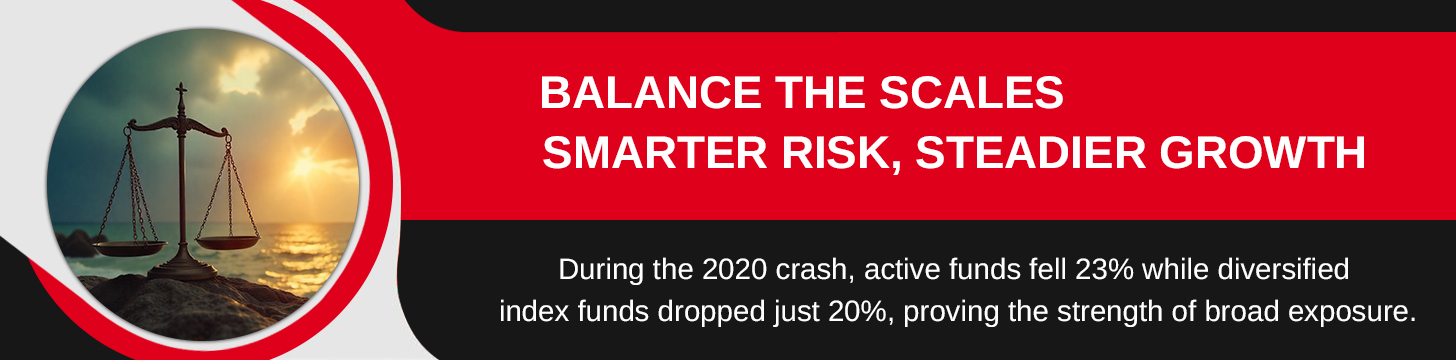
When comparing managed funds and index funds, risk and diversification play a big part in long-term returns.
Managed funds take active positions — they concentrate on specific sectors or companies to chase higher returns.
This can lead to higher volatility, especially during market downturns.
Index funds provide built-in diversification by holding every stock in the chosen benchmark such as the S&P/ASX 200.
This spreads the risk across industries, so any one stock’s decline has less impact.
Example
During the 2020 COVID-19 market crash, actively managed funds in Australia fell on average 23%, while diversified index funds tracking the ASX 200 fell around 20%, showing a smaller drawdown due to broader exposure.
Why does diversification matter?
- Reduces risk – spreads investments across multiple sectors and asset classes.
- Smooths return – fewer big ups and downs.
- Long-term stability – avoids overexposure to underperforming stocks.
Behaviourally, many investors switch out of managed funds when short-term performance dips, locking in losses.
Index fund investors tend to stay invested longer and benefit from market recovery and compounding.
So while managed funds may suit risk-tolerant, opportunistic investors, index funds are better for steady, disciplined wealth builders.
Investment Access – How Australians Can Start Small and Grow Big?

Getting access to managed or index funds has never been easier in Australia. Traditional managed funds used to require large minimum investments — often $5,000 to $20,000 — and paper-based applications.
Now digital investment platforms have democratised entry, so Australians can start with as little as $500.
Index funds are available through low-cost brokers and apps like Vanguard Personal Investor, CommSec Pocket, Pearler, and Raiz.
These platforms offer fractional investing, automatic reinvestment plans and easy diversification for beginners.
Example
A Finder (2025) study found that 68% of new Australian investors started with index-based products like ETFs because of ease of access and low start up costs.
Why access has improved?
- Digital platforms eliminate paperwork and intermediaries.
- Lower minimum investment thresholds encourage younger investors to start early.
- Micro-investing apps automate small, regular contributions, building discipline over time.
Managed funds still dominate among institutional investors and high-net-worth individuals because of tailored strategies and professional management.
But for most Australians, index funds are a cost-effective, accessible and user-friendly entry point into long term wealth creation.
This has opened up the markets to everyday Australians that were previously reserved for professionals.
The Future of Managed and Index Investing in 2026 and Beyond
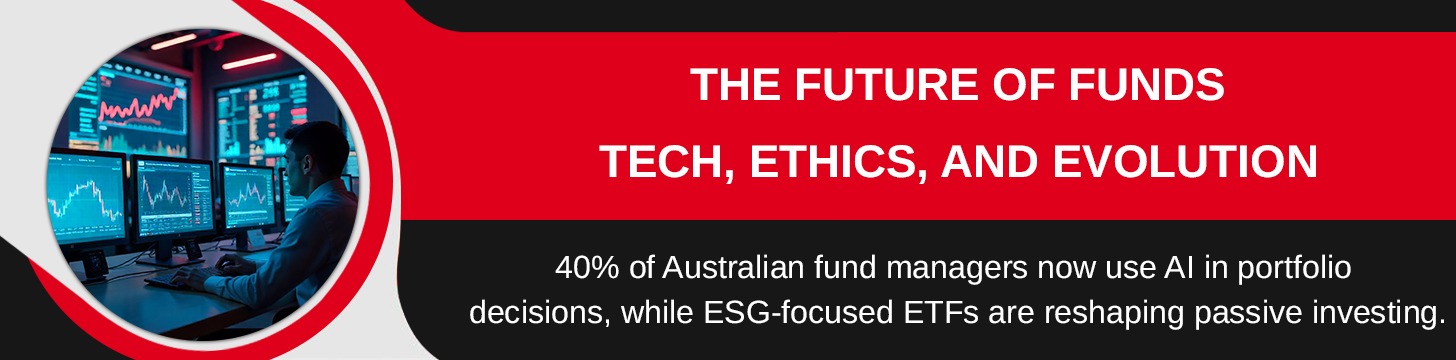
The future of investing in Australia is being shaped by technology, sustainability and changing investor behaviour.
Both managed and index funds are adapting to the demands of a new generation that wants data-driven insights, ethical investing and automation.
Managed funds are using AI-driven portfolio management to analyse millions of data points in real time.
According to KPMG Australia (2025), nearly 40% of active fund managers have integrated artificial intelligence or machine learning into their decision making to improve accuracy and reduce bias.
This allows managers to react faster to market trends and economic changes. Index funds are evolving too.
Providers like BetaShares and Vanguard are launching thematic ETFs on clean energy, robotics and ESG (Environmental, Social and Governance) sectors.
These funds track indices that align with future megatrends so investors can get exposure to industries that will grow beyond 2030.
Why this is happening?
- Technological advancement improving fund efficiency.
- Increased ESG focus among Australian investors (65% prefer sustainable portfolios – ASIC, 2024).
- Younger demographics favouring digital-first, low cost options.
By 2026 and beyond, hybrid strategies combining active intelligence and passive structure will likely dominate Australia’s investment landscape.
Smart Investor Blueprint – When to Choose Managed or Index Funds
Choosing between managed funds and index funds depends on your goals, time horizon and risk tolerance.Each has its advantages and knowing when to use them can help Australians build a balanced, future-proof portfolio.
Managed funds are for
- Those who want professional management and tailored strategies.
- Those seeking exposure to niche markets or specialised sectors (e.g. infrastructure, ESG, small caps).
- Those with higher capital and willing to pay extra for potential outperformance.
Index funds are for:
- Long term investors looking for low cost, steady growth.
- Those seeking broad diversification across the entire market.
- Those building wealth through regular contributions, such as dollar-cost averaging.
Example
Data from Morningstar (2025) shows that Australian investors holding index funds for 10+ years achieved 7.2% average annual returns compared to 6.1% for the median actively managed fund. This is the power of low cost investing.
FAQs – Managed Funds vs Index Funds in Australia
1. What is the Main Difference Between Managed Funds and Index Funds?
Managed funds are run by professional fund managers who use their skills and experience to pick investments based on what they think will do well.
Index funds on the other hand are pretty hands-off – they just track a market index such as the ASX 200, rather than trying to beat the market.
The biggest distinction lies in how they approach their investments and how much they cost. Managed funds are trying to outperform the market, while index funds are happy to just match it.
Because they don’t have all these fancy investment decisions to make, index funds tend to be a lot cheaper and generally easier for long-term investors to keep an eye on.
2. Which Performs Better Over Time?
Over time, index funds tend to be more consistent because they avoid all the high management costs and mistakes that fund managers can make.
Managed funds can occasionally do better in certain market conditions, but this isn’t a given and a lot depends on the individual manager’s skills and expertise.
For most people, index funds offer solid, steady returns that reflect how the market as a whole is doing, making them a pretty sensible choice for building your wealth.
3. What Are the Fee Differences Between Managed and Index Funds?
Managed funds tend to charge a lot more in management fees, sometimes up to 2%, plus extra fees if they happen to perform above their targets.
Index funds on the other hand are much cheaper usually charging below 0.3% per year because they don’t have to pay for all the fancy research teams and buy-and-sell activity.
Over time, this fee difference can really add up, making index funds the way to go if you want to keep more of your hard-earned cash.
4. Are Index Funds Riskier Than Managed Funds?
Both types of funds carry market risk, in that their value will go up and down along with the market.
Index funds just reflect what’s happening in the market, there’s no special effort being made to manage the risk.
Managed funds might try to cut risk down to size through diversification or adjusting their strategy, but the outcome will still depend on the fund manager’s decisions.
In general, index funds offer a lot of clarity and stability, while managed funds introduce a bit more uncertainty through the manager’s decisions.
5. Which is Better for Australian Investors in the Future?
For most long-term investors, index funds offer a simple, low-cost way to grow your wealth.
They suit people who are comfortable with steady market-based returns and don’t want too much fuss from the investment manager.
However, if you’re looking for specialised investment opportunities like technology, sustainability, or small-cap growth – then managed funds might be worth considering.
The best option is probably a balanced mix of both – combining the stability of index investing with the potential of active management.