

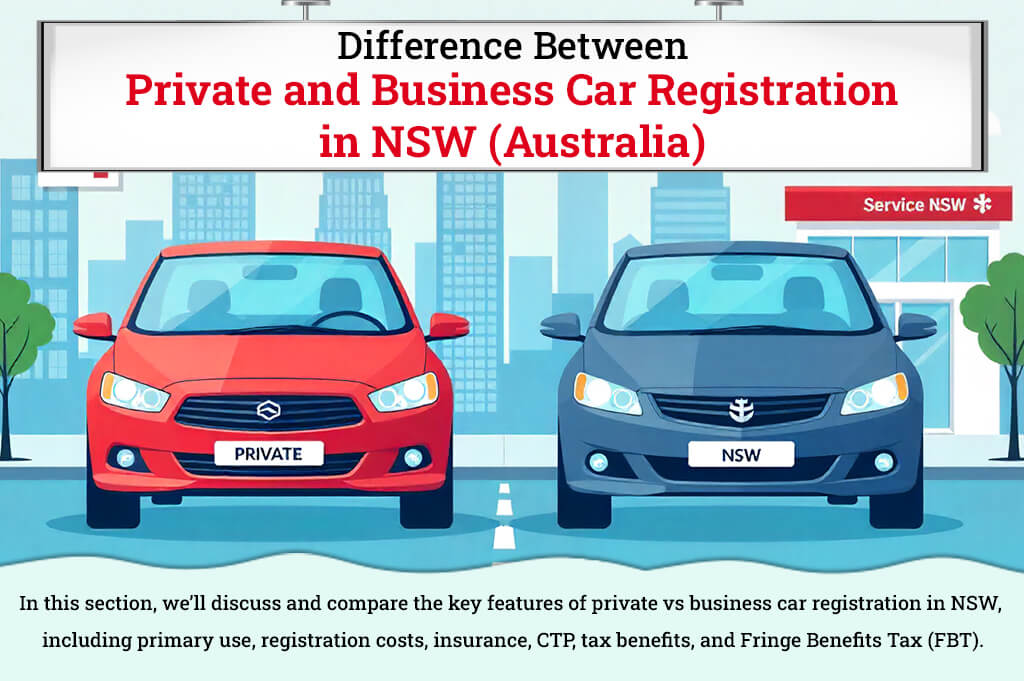





In New South Wales, getting a handle on the difference between private and business vehicle regos is a must for anyone owning or operating a vehicle. You’ve got to take note of this distinction, especially given the size of the state’s vehicle fleet.
As of January 2023, NSW has around 6.15 million registered motor vehicles on the road, which puts it as the state with the most registered vehicles in Australia. That’s a pretty big number, and it highlights just how critical it is to get your vehicle rego right.
When you’ve got a massive fleet like NSW has, you need to make sure you’re categorizing vehicle usage properly. This ensures you’re complying with the rules and getting the most out of any available tax perks.
Choosing between private and business rego affects a bunch of different things. You’ve got to think about tax, insurance, and any government incentives you might be eligible for.
For example, if you’re using your vehicle for business, you might be able to get in on the Instant Asset Write-Off scheme which lets businesses claim upfront on any eligible assets.
But on the flip side, private vehicle regos are all about personal use and you don’t typically get the same tax benefits.
The type of rego you’ve got can also impact your insurance – business vehicles usually need commercial insurance which is different from the run of the mill private vehicle insurance in terms of what’s covered and how much it costs.
Which is all the more reason why it’s pretty crucial for blokes and sheilas in NSW to get their head around what their vehicle is actually for. Getting it wrong can lead to all sorts of problems – even some serious financial penalties.
If you want the lowdown on rego types and what it all means, check out the official Transport for NSW sites. They’ve got all the information you need to get it sorted.
Private and Business Car Registration in NSW – Quick Comparison
| Feature | Private registration | Business registration |
| Usage code recorded (NSW) | “PRIV” usage usually | “BUSG” or commercial usage |
| Vehicle tax rate | Lower tax band (e.g., $579 for 1,505-2,504kg) | Higher tax band (e.g., $897 for same weight) |
| Annual base rego fee | $82 | Same base fee, but tax higher |
| Recorded vehicle count by usage | TfNSW tracks vehicle counts by usage monthly | Same data source |
| Insurance risk profile | Standard private cover likely | Commercial cover likely needed |
| Tax deductions/GST | Limited to business-use portion | Broader deductions + GST credits possible |
| FBT exposure | Minimal (if privately owned and private use) | Higher risk of FBT if vehicle available for private use |
| Admin/record-keeping | Lower burden | Higher burden (logbooks, business records, usage tracking) |
NSW Points We’ll Be Referencing
Rego fees & motor vehicle tax, tare-weight bands, 1 July 2025 fee updates, usage codes PRIV (private) and BUSG (business), CTP requirements, ATO rules for deductions and Fringe Benefits Tax (FBT).
Detailed Difference Between Private and Business Car Registration in NSW
1. Usage and Registered Vehicles
- According to the Transport for NSW (TfNSW) Open Data “Registered Vehicles by Usage Snapshot”, the government tracks vehicles by usage code (e.g., private vs business) in NSW.
- NSW doesn’t publish a simple “X% business vs Y% private” breakdown in the publicly-summarised page, but the data set shows usage classification is actively recorded and updated monthly.
- Since usage is tracked, the distinction between “private” and “business” registration is meaningful and enforced in practice (you can’t just claim business use is unrecorded).
2. Costs: Registration Fee + Vehicle Tax
- For all light vehicles in TfNSW the registration fee is $82 annually (as of current guidance) for private usage.
- The additional vehicle tax (sometimes called “motor vehicle tax” or “vehicle tax” by TfNSW) depends on the tare weight of the vehicle and the usage (private or business). The official page states:
“Vehicle tax is calculated based on the tare (unladen) weight of the vehicle. Vehicles used for business purposes attract a higher vehicle tax than those for private use.”
- Example data from the fee table: For a car 1,505-2,504kg tare:
- Private use: $579 vehicle tax
- Business use: $897 vehicle tax
3. Insurance and Risk Profile

- Although the official stats pages don’t give a breakdown of insurance claims by usage, the key point: business-use vehicles (carrying passengers, goods, tools, higher mileage) are a higher risk profile and insurers reflect that.
- If you register as “private” but use the vehicle for business – risk of invalid insurance claim and non-compliance. Several competitor blogs mentioned this.
4. Tax: Deductions, GST & FBT
- The ATO says:
- If you own the car personally (private registration) and use it for business travel, you can claim up to certain limits via logbook or cents-per-km.
- If the vehicle is owned by a company/trust and registered for business use, you can claim running costs and GST credits (if GST registered). Then if the vehicle is made available for private use, FBT applies.
- NSW’s dataset doesn’t show how many vehicles incur FBT or GST credits, but the rules are clearly different.
5. Administrative/Compliance Burden
- Usage Codes: If you live in NSW, you’ll need to change the vehicle’s usage (like from PRIV to BUSG) through Service NSW.
- You’ll need to provide proof of identity, business details and all that jazz.
- Tracking for Tax: If you’re using the car for business trips, keeping a logbook and recording your mileage is a good idea (especially if you’re claiming deductions and FBT comes into play).
- Cost Changes: Transport for NSW have said that come 1 July 2025 some tax amounts are going to go up due to indexation and catching up on past oversights.
NSW Cost Example: Private vs Business Rego
Let’s say we have an example vehicle: a mid-size SUV with a tare of around 1,600kg (fits neatly into the 1,500-2,500kg band).
1. Registration fee – this is the same either way
- It’s $82 per year for all light vehicles.
2. Motor Vehicle Tax – this varies depending on usage
NSW calculates the Motor Vehicle Tax (MVT) from a table of tax units by tare band and usage. From next year ( 1 July 2025 ) each tax unit will be worth $1 (rounded).
If you look at the NSW schedule for a “Motor car or station wagon” (tare 1,500-2,500kg) we get:
- Used mostly for private purposes (lower tax): 503 tax units = $503.
- Not used for private stuff (ie business use – lower tax): 804 tax units = $804.
If your car is in a different weight range just pick the relevant row instead. NSW updates the amounts every year and publishes the table with the new values.
3. Total (before CTP/plates/inspection)
| Usage | Reg fee | Motor Vehicle Tax | Subtotal |
| Private | $82 | $503 | $585 |
| Business | $82 | $804 | $886 |
What’s the difference for the same car: About $301 more for business rego, thanks to the higher MVT band for business use. (You’ll also need to factor in CTP green slip, number plates and any inspection fees.)
Practical Notes
- Usage codes matter: NSW records usage as PRIV (private) or BUSG (business general). If you start using your car for something different (like rideshare or deliveries) you’ll need to update your usage/courtesy name with Service NSW (you can often do this over the phone if you meet the right criteria).
- Insurance: You definitely need to have CTP (Green Slip) before you can register the car; if you’re using it for business pick a commercial motor policy (private policies might refuse to pay out if you use it for business).
- Tax implications:
- Personal ownership (private rego): Just claim the bits you used for business with the ATO (cents-per-km or logbook).
- Company/trust ownership (business rego): There’s more in terms of deductions and potential GST credits if you’re registered for GST. FBT might apply if the car is available for private use (with some exemptions for eligible “workhorse” vehicles and a separate EV exemption).
- 2025 indexation & clean-up: NSW confirmed 2025 price increases (fees up 3.22%, MVT up 1.61%) and a 2025 correction to some past MVT calculations—so costs this year might be different from what you paid last year.
Private or Business Car Registration – What to Choose?
Go for private registration if:
- The car is really for personal use with only a little bit of occasional business travel.
- You prefer a simple tax claim (cents-per-km or logbook %), and don’t want to deal with FBT headaches
Choose business registration if:
- The vehicle is mainly income-earning (rideshare, delivery, mobile trade, sales/service calls).
- Your entity is GST-registered and you want to claim GST credits and more.
- You can manage FBT (or you’re exempt—for example, a genuine workhorse ute with limited private use).
Pro Tip for Small Businesses
If FBT is the hold up, talk to your accountant about policy settings (e.g., restricting private use, EV incentives, or using personally owned vehicles with logbook claims instead).
How to Switch From Private to Business in NSW (or Vice-versa)?
- Confirm the main use and talk to your insurer about the right policy.
- Update usage via Service NSW (BUSG ↔ PRIV) and add a courtesy name if applicable. Bring ID and business details. Some changes can be done by phone.
- Renew CTP (Green Slip) aligned with the new usage and policy.
- Adjust your tax records: start/keep a logbook, capture tax invoices, and review FBT if the car is company-owned.
Conclusion
For NSW drivers, it’s all about usage, cost, cover and compliance. Private rego is simpler and cheaper but limits tax outcomes. Business rego is better for income-earning use and can get you GST credits and more, with FBT to manage if there’s private use. Whatever you choose, anchor it to your true main use, keep your usage code correct (PRIV/BUSG), carry CTP before you register and keep ATO-grade records.
FAQ – Private and Business Car Registration Differences in NSW
1. Does It Cost More to Register a Vehicle in a Company Name?
Yes, registering a vehicle under a company name in NSW costs more. The base registration fee is the same but business use attracts a higher motor vehicle tax. For example a 1,505–2,504 kg tare weight vehicle has a vehicle tax of $897 for business use compared to $579 for private use.
2. Is Car Rego a Business Expense?
Yes if a vehicle is used for business purposes the registration fee is a business expense. This includes the registration fee, motor vehicle tax and other related costs. But if the vehicle is used for both business and personal purposes only the business use portion is deductible and accurate records must be kept to support the claim.
3. What Are the Benefits of Buying a Car Through a Business?
Here are the main benefits of buying a car through your business:
- GST Credits: Claim GST on the purchase price and running costs (if GST registered).
- Depreciation: Deduct the vehicle’s depreciation over time, reducing taxable income.
- Instant Asset Write-off: Eligible businesses can claim an immediate deduction on purchases under certain thresholds.
- Tax Deductions: Claim vehicle expenses like fuel, insurance and maintenance based on business use.
- Fleet Discounts: Potential for lower purchase prices through business fleet deals.
These benefits can save you money owning a vehicle through your business.
4. Why Are Cars Cheaper for ABN Holders?
ABN holders can get fleet discounts and negotiate better deals with dealerships often resulting in lower purchase prices. Businesses can also claim GST credits on the purchase price, effectively reducing the cost. But buying a vehicle under an ABN may have tax implications such as Fringe Benefits Tax if the vehicle is used for personal purposes.
5. What is the Most Tax Efficient Way to Buy a Company Car?
The most tax efficient way depends on your business structure and usage. Options include:
- Chattel Mortgage: Allows GST credits on the purchase price and interest deductions.
- Finance Lease: Provides deductions for lease payments and potential GST credits.
- Novated Lease: Suitable for employees, offers salary packaging benefits.