






Rental yield is one of the key metrics for property investors in Australia. It shows how much income a property generates compared to its purchase price, so investors can work out if an investment is viable.
In simple terms, rental yield is the annual rental income as a percentage of the property’s value — before expenses like maintenance, insurance and taxes are considered.
To calculate rental yield investors use the formula:
Rental Yield (%) = (Annual Rent ÷ Property Value) × 100
For example if a property worth $600,000 earns $600 per week, the annual rent is $31,200. The rental yield would be (31,200 ÷ 600,000) × 100 = 5.2%. This means the property earns 5.2% of its value in rental income per year — a useful benchmark to compare different options.
In Australia the average gross rental yield for houses in capital cities is 3.5% to 4.5%, while units are often 4.5% to 6% according to CoreLogic’s 2025 data.
Regional areas like Perth, Adelaide and parts of Queensland have shown stronger yields, often above 5%, due to affordable prices and strong rental demand.
Knowing how to calculate and understand rental yield helps investors make informed decisions whether they are comparing suburbs, assessing off-the-plan apartments or building long term portfolios.
In today’s data driven property landscape knowing the yield is not just about quick returns — it’s about having a sustainable investment strategy in Australia’s changing real estate market.
Rental Yield in Australia – The Foundation of Smart Property Investing

Rental yield is one of the most practical ways to measure property performance in Australia. It’s the annual return (rental income) expressed as a percentage of the property’s purchase price or current market value. This allows investors to work out if their property is producing sufficient income relative to its cost.
There are two types of rental yield — gross and net.
- Gross yield is calculated before expenses and is good for quick comparisons.
- Net yield includes costs like insurance, maintenance, property management fees and council rates — gives a more accurate picture of true profitability.
In Australia yields differ. SQM Research (2025) says houses are around 4.1% and units are 5% due to lower purchase prices and higher tenant demand in the city.
Investors use rental yield because:
- It determines how well your property covers your mortgage repayments and other expenses.
- It helps you work out cash flow positive vs negatively geared investments.
- It allows you to compare risk vs reward especially when comparing cities like Melbourne (3.5%) and Adelaide (4.7%).
For example an investor buying a $500,000 apartment in Brisbane earning $500 per week would get a gross yield of around 5.2% which is considered good for balanced cash flow and growth.
Ultimately rental yield serves as a pretty good way to see how well your investment property is doing. It’s the scorecard that lets you know if your place is raking it in or falling well short. The more you understand this figure the smarter your decisions will be – whether it’s choosing the right area, or upping the rent to get a better return – the aim is to keep your investment afloat in Australia’s crazy property market.
How to Calculate Rental Yield – The Math Behind Property Profit
Working out rental yield might seem like a no-brainer, but it’s one of the single best tools you’ve got for figuring out just how profitable your investment property really is.
It gives you a real number to look at and lets you see just how much income your property is churning out compared to its value. This makes it dead simple to figure out if the property will be providing a steady stream of cash or eating away at your finances over time.
There are two main formulas used in Australia — Gross Rental Yield and Net Rental Yield.
Formula for Gross Rental Yield Calculation
Gross Rental Yield (%) = (Annual Rental Income / Property’s Purchase Price) x 100
Formula for Net Rental Yield Calculation
Net Rental Yield (%) = (Annual rental income – Annual expenses) / Property value x 100%
These formulas are widely accepted by Domain, and other property research groups as the industry standard for yield analysis.
Let’s take a practical Australian example:
| Detail | Amount (AUD) |
| Property Purchase Price | $600,000 |
| Weekly Rent | $550 |
| Annual Rent | $550 × 52 = $28,600 |
| Annual Expenses (rates, insurance, maintenance) | $4,000 |
Gross Yield: (28,600 ÷ 600,000) × 100 = 4.76%
Net Yield: ((28,600 – 4,000) ÷ 600,000) × 100 = 4.1%
This example highlights the impact of costs on returns. While gross yield paints a quick overview, the net yield gives a truer reflection of cash flow performance after outgoings.
Investors use these formulas because they:
- Enable fast comparisons between multiple properties.
- Help identify cash flow positive investments.
- Provide insights into risk-adjusted returns when matched with interest rates or inflation.
In 2025, with average mortgage rates around 6%, any property yielding above 5% net can still produce healthy income — making yield calculation an essential skill for every Australian property investor aiming for long-term profitability.
Example Calculation – A Step-by-Step Australian Property Scenario
Understanding how to calculate rental yield becomes clearer through a real-world example. By walking through the numbers, investors can see exactly how income, costs, and property value interact to shape profitability.
Let’s consider a Brisbane investment property valued at $500,000, earning a weekly rent of $480.
Step 1: Calculate Annual Rent
$480 × 52 weeks = $24,960 per year.
This is the total gross income the property generates annually.
Step 2: Apply the Gross Yield Formula
Gross Yield = (24,960/500,000) × 100 = 4.99%
This indicates the property earns just under 5% of its value each year in rent before costs.
Step 3: Deduct Annual Expenses
Let’s include typical yearly costs:
- Council rates: $1,500
- Insurance: $1,200
- Maintenance: $2,000
Total = $4,700.
Step 4: Apply the Net Yield Formula
Net Yield = ((24,960 – 4,700)/500,000) × 100 = 4.04%
This example demonstrates how expenses reduce your actual return by nearly 1%, which may seem small but adds up to thousands of dollars over time.
Across Australia, similar calculations reveal regional variations.
For instance:
- Sydney yields average around 3.2%, mainly due to high purchase prices.
- Perth and Darwin often exceed 5.5%, offering stronger cash flow.
Investors use such examples to:
- Benchmark their returns against national averages.
- Understand the impact of operating costs.
- Compare opportunities between growth-focused and cash-flow-driven markets.
This step-by-step method transforms raw numbers into insight — empowering investors to make smarter, data-backed property decisions in Australia’s diverse real estate landscape.
Gross vs Net Rental Yield – The Balancing Act Between Cash Flow and Reality

**Understanding the difference between Gross and Net Rent Yield is a crucial part of being a savvy Australian property investor. Both metrics give you a picture of how well a property is doing financially but they give you different information to work with in your investment analysis.
Gross Rental Yield shows you the potential of a property – the total annual rent as a percentage of its purchase price. It’s a pretty easy number to calculate and is often the first thing investors look at when comparing properties. That being said, it doesn’t take into account the actual costs of owning a property in real life.
Net Rental Yield gives you a more accurate view of a property’s cash flow health. It takes into account all the essential expenses that come with owning property such as
- Property management fees (they typically range between 6-8% of the rent)
- Maintenance and repairs (which can be a shock, believe me!)
- Insurance (to protect your investment from all those what-ifs)
- Council rates and strata fees (just a couple of things you’ll need to keep on top of)
- Vacancy periods (the times when your place is unrented and you’re not earning any rent)
By considering all these costs net yield gives you a more realistic view of a property’s profitability.
Here’s a quick comparison to sum things up:
| Yield Type | Formula | Purpose | Average in Australia (2025) |
| Gross Yield | (Annual Rent ÷ Property Value) × 100 | Quick property comparison | 3% – 6% |
| Net Yield | ((Annual Rent – Expenses) ÷ Property Value) × 100 | Real cash flow analysis | 2.5% – 5% |
Take the example of a Melbourne apartment worth $700,000 and renting for $650/week. The Gross Yield is 4.8% but once you deduct the annual expenses of $5,000 the Net Yield drops to 4.0%. Now that’s a significant difference and one that can have a big impact on your loan coverage and profits long-term.
Investors who are after cash-flow stability are much more interested in net yield than those targeting capital growth who tend to rely on gross yield for a quick comparison. In short, gross yield shows you the potential but net yield shows you the reality of the situation and savvy investors will look at both to ensure they get the best possible returns.
Factors Influencing Rental Yield – The Key Drivers Behind Profitability
When it comes to rental yield it’s not just one thing that determines it – it’s a combination of market conditions, property characteristics and the investment strategy that you’re using. If you want to get your head around the most profitable suburbs then you need to understand how these various factors come together to drive profitability.
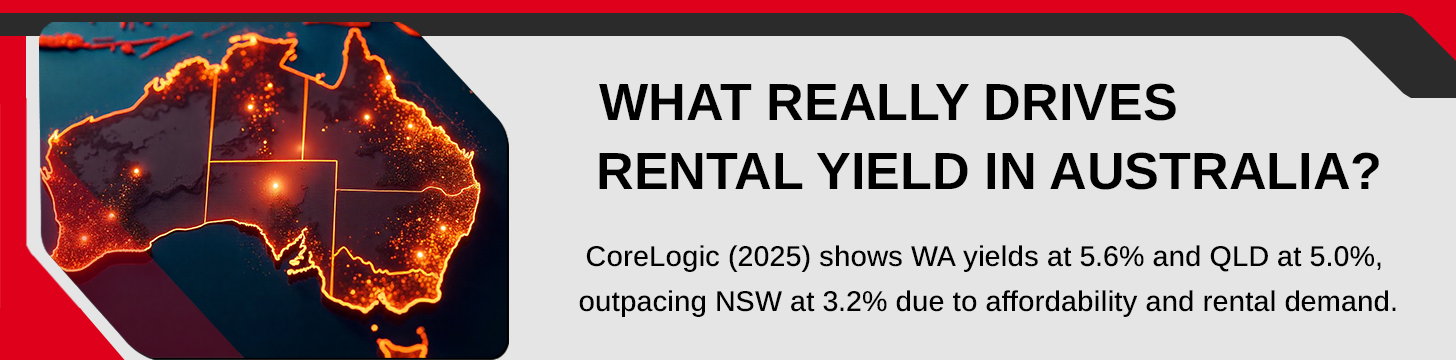
As you’d expect, data shows that there are some big differences between the states here in Australia. For example Western Australia (5.6%) and Queensland (5.0%) have some of the highest average gross yields while Victoria (3.3%) and New South Wales (3.2%) sit a bit lower due to higher property prices and lower relative rents.
What key factors impact Rental Yield:
- Location
- Property Type
- Market Demand and Vacancy Rates
- Expenses and Maintenance Costs
- Economic Conditions
If you understand these factors then you can get high performing suburbs and which ones to steer clear of – and ultimately that’s the best way to maximise your returns in the ever-changing real estate market.
Average Rental Yields by State – The Australian Investment Snapshot

There’s a big difference in rental yields across Australia – and it’s all down to regional economics, housing supply and local rental demand. If you want to get a sense of where your money is most likely to grow then you need to look at the average rental yields by state.
By doing that you can get a sense of where you’re most likely to get a good balance of cash flow and growth potential for your investment.
Average Gross Rental Yields (2025)
| State/Territory | Houses | Units | Key Insight |
| New South Wales (NSW) | 3.2% | 4.1% | High prices in Sydney reduce returns |
| Victoria (VIC) | 3.3% | 4.3% | Yields improving as rents rise post-2024 |
| Queensland (QLD) | 4.5% | 5.0% | Strong migration and rental shortage |
| Western Australia (WA) | 5.6% | 6.0% | Nation’s best yield performer |
| South Australia (SA) | 4.2% | 4.8% | Steady growth, low vacancy rates |
| Tasmania (TAS) | 4.5% | 5.2% | Consistent rental demand and limited stock |
| Northern Territory (NT) | 5.7% | 6.3% | Small market but strong yield potential |
| Australian Capital Territory (ACT) | 3.8% | 4.4% | Stable government rental base |
Key Observations
- Western Australia and the Northern Territory are currently the front-runners for yield performance, largely because properties in these areas are super affordable – and there’s just not enough rentals to go around.
- Queensland is still in high demand from investors looking for a stable income.
- New South Wales and Victoria – while their yields might be a bit lower – are attracting investors who are expecting long-term growth in property value.
These figures are revealing all sorts of things about how yield trends are tied to local economic conditions. If you’re after a steady income you’re probably looking at Perth, Darwin, or regional Queensland. If you’re after growth, then you’re probably in the market for a place in Melbourne or Sydney.
Getting a handle on state-by-state yield averages is essential for investors who want to diversify their portfolios and set themselves up for long-term success with both a healthy cash flow and steady growth in property value.
Tools and Calculators
In today’s world where just about everything is on the internet, rental yield calculators and property analysis tools have become essential tools for any Australian investor who wants to get fast, accurate and data-backed insights.
Instead of getting bogged down in tedious number-crunching, these online platforms automate all the calculations and integrate live suburb-level statistics, making it a whole lot easier to compare investment opportunities across the country.
Why Use Rental Yield Calculators?
Trying to crunch all the numbers yourself can lead to tiny errors in your yield calculations. And before you know it these little mistakes have added up and are distorting the real picture.
These digital tools make it all a whole lot easier – providing instant results – so you can make informed decisions backed up by real-time data – not just guesswork.
Key benefits include:
- Automation: No more chance of manual errors creeping into your yield calculations.
- Data Integration: It syncs with live rental and property value databases – so you get the most up-to-date information.
- Comparison: Easy benchmarking across multiple properties or suburbs – so you can see what’s working and what’s not.
- Forecasting: Some of these calculators even give you growth projections and expense estimators – so you can get a handle on where your investment is headed.
Popular Australian Rental Yield Tools (The Ones Everyone Uses):
| Platform | Key Features | Why It’s Useful |
| Domain Investment Tools | Offers rental yield and vacancy rate dashboards | Great for property comparisons |
| REA Group Calculator | Simple yield computation with custom expense inputs | Ideal for first-time investors |
| ATO Property Return Estimator | Government-backed tool for income and tax estimation | Helps align yield with after-tax returns |
Example
Let’s say you’re a Brisbane investor and you enter in a property value of $550,000 and a weekly rent of $520 into CoreLogic’s calculator and instantly see that the gross yield is 4.9%. And to help you understand the deal a bit better it also gives you the average yield for nearby suburbs.
By using these tools, you save time and get a much clearer picture of how profitable your property is, so that every decision you make aligns with the financial goals you’ve set for yourself – and with how the Australian market is evolving.
How to Improve Rental Yield – Strategies That Will Boost Property Performance

Boosting rental yield is a bit more than just jacking up the rent – its about optimising the value of your property, keeping a lid on expenses and making your property more attractive to tenants. In Australia’s super competitive housing market, even small adjustments can make a huge difference to how much return you get and how much cash flow you get out of your investment.
Proven Ways to Increase Rental Yield
Renovate with a Clear Head
Don’t go crazy with the renovations – just do the basics like give the place a lick of paint, update the lighting or give the kitchen and bathroom a bit of a makeover. And that can get you a rent increase of 5 to 10% off the bat. For instance, upgrading a $500,000 place that’s renting for $480 a week to one renting for $550 a week takes the gross yield from 4.99% to 5.72%.
Offer a Package Deal
Furnished properties in the city or near universities are always going to get a higher rent – often 10 to 20% more – especially in places like Brisbane, Melbourne and Sydney.
Cut Your Costs
Switch to energy-efficient appliances, get some solar panels or take over managing the property yourself – and you can cut your annual costs by 2 to 3,000 dollars – which can give you a nice lift in the net yield.
Review Your Rent Regularly
Review your rent annually and make sure you’re not getting left behind in the market – so your tenants are paying a rent that’s in line with what’s happening in the market.
Add Some Extras
Add some extras like air-conditioning, secure parking or an outdoor living space – and your tenants are going to be happy as clams. That reduces your vacancy periods and means you can charge a higher rent.
Conclusion – Turning Rental Yield Insights into Investment Power
Across Australia, performance of rental yields has remained a key snapshot of the property market’s overall health. According to SQM Research , the national average gross rental yield has climbed to 4.5%, up from 4.0% in 2023 thanks to the record-low vacancy rates & relentless demand from tenants. This shows that investors who take the time to grasp and keep an eye on rental yields are better placed to quickly adapt to market changes & stay profitable.
Why Rental Yield Matters in Your Long-Term Property Strategy
Tells You How Profitable The Investment Is
Rental yield helps you figure out how well your property investment is really doing – especially when mortgage rates are knocking on the door at 6%.
Strikes the Right Balance Between Risk & Return
High-yield areas (like Perth or Darwin) can offer strong cash flow but at the cost of slower long-term growth in value. Conversely low-yield areas (like Sydney) may promise big appreciation in value over time but require you to have a stronger financial position.
Allows You to Plan Your Property Portfolio
Investors often mix & match growth-focused and income-focused properties to keep generating a steady income even when the market cools off.
FAQs: How to Calculate Rental Yield in Australia
1. What is Rental Yield and Why is It Important for Investors?
Rental yield calculates the percentage of annual rent earned from a property compared to its purchase price – or its current market value.
It lets you judge the income-generating potential of a property & decides whether it’s going to deliver a good return on your investment. The higher the yield, the stronger the cash flow & the better the property is likely to be performing.
For example, if a property is worth $600,000 and pulls in $30,000 in annual rent, then the yield is 5%. Understanding rental yield just makes it that much easier to compare different suburbs, property types, & price ranges ahead of committing to a purchase.
2. How Do I Calculate the Gross Rental Yield?
The gross rental yield formula is dead easy:
(Annual Rental Income Divided by Property Value) x 100
For instance, if you buy a house for $500k and it rakes in $25k per year, the yield comes out at 5%. This formula gives a quick snap-shot of potential income but neglects the ongoing expenses you’ll need to pay such as insurance, maintenance, and property management.
It’s useful for doing an initial comparison between several properties but to get an accurate picture of your profit, you’ll need to run the numbers on your net rental yield as well.
3. What is the Difference Between Gross and Net Rental Yield?
Gross yield just looks at the income against the property value whereas net yield factors in all the ongoing expenses.
Common expenses included are things like:
- Council and water rates
- Insurance premiums
- Property management fees
- Maintenance and repairs
For example, if your property earns $30,000 each year but you are left with only $25,000 after expenses, the net yield will be lower – probably around 4%. Net yield gives a more accurate picture of what your real return is after costs are taken into account.
4. What Are Typical Rental Yields Across Australia?
National averages tell us that gross rental yields usually fall somewhere in the range of
- 3.7 to 4.5 percent for houses
- and 4.5 to 6.0 percent for units
We see some regional markets like Adelaide, Brisbane and Perth performing particularly well. I think this is because property prices are relatively affordable and there’s a strong demand from renters.
Sydney and Melbourne on the other hand tend to do a bit worse. This is because they have some of the highest property values in the country and it’s getting pretty competitive when it comes to renting.
If you keep an eye on the yields across both capital cities and regional areas then you might be able to identify which ones are performing the best.
5. How Can I Improve My Property’s Rental Yield?
To boost that rental yield you’ve got to think about getting more income and cutting costs.
Here are some ideas that might help:
- Give the old place a revamp: Make it look modern and you’ll probably attract better-paying tenants.
- Think about furnishing: If you can offer furnished rentals you might be able to attract short-term or corporate tenants who are willing to pay a bit more.
- Keep an eye on the rent: Adjust it every now and then to make sure it’s in line with current market trends.
- Keep costs down: Shop around for insurance and management fees – you might be able to save some money.
Making small improvements to the way you present the property and keep costs in check can make a big difference to your long term returns and overall yield performance.