






In the fast-paced world of Australian business, travelling for work has become more than just a necessity – it’s an investment in connections, growth and innovation. The good news? As a business owner in Australia, you may be eligible to claim tax deductions for a range of travel-related expenses – and understanding how these work with Australian Taxation Office (ATO) rules can make a real difference to your bottom line.
- The ATO says you can claim a deduction for travel expenses incurred when you or your employee travel for business purposes, including day trips, overnight stays or multi-night trips.
- For the 2025-26 income year, the ATO’s updated rules (under TD 2025/4) set “reasonable” allowance rates for accommodation, food and incidentals that employees incur while travelling for business.
- Business travel is back in motion: according to a corporate travel survey, around 40% of Australian businesses plan to increase their travel in the 2025 fiscal year, so business travel spend is once again on the rise.
What Can Be Deducted?
Several costs associated with business travel can be claimed as tax deductions, including:
- Transport Costs: This includes expenses for flights, trains, buses, and car hire. If you use your personal vehicle for business travel, you can claim deductions for the distance travelled at the ATO’s prescribed rate.
- Accommodation: Expenses for hotels, motels or any temporary accommodation you use while travelling for business purposes can be deducted.
- Meals and Entertainment: You can claim meal expenses incurred during business trips, as long as they are necessary for the business activities you’re engaged in. However, entertainment costs like sporting events or recreational activities are generally not deductible unless they are directly tied to a business purpose.
- Incidental Expenses: This includes items like phone calls, internet usage, taxi fares and other miscellaneous expenses that are necessary for business operations while travelling.
Key Considerations for Claiming Business Travel Deductions
To claim deductions successfully, here are some things to consider:
- Record Keeping: You must keep accurate records of your travel expenses, such as receipts, invoices and a detailed travel diary. The ATO may ask you to provide evidence for your claims, so thorough documentation is essential.
- Apportionment: If your travel involves both personal and business activities, you can only claim the portion of the expenses that relates to the business component. For example, if you extend a business trip for a personal holiday, you can’t claim deductions for the entire duration.
- 3. Overseas Travel: You can also claim tax deductions for overseas travel but the rules for overseas travel are more complex and it’s recommended you consult with a tax professional to ensure you’re complying with Australian tax laws.
In summary, knowing what qualifies as a business travel tax deduction in Australia can make a big difference to your business. Make sure your travel expenses are documented and always align your claims with the ATO’s rules.
Introduction to Business Travel Tax Deductions in Australia
Business travel tax deductions allow Australian business owners, employees and contractors to claim tax relief on expenses incurred during work related travel. Understanding the basics of these deductions is key to ensuring eligible expenses are claimed correctly and tax savings are maximised.
To qualify for business travel deductions the trip must have a legitimate business purpose. This means the primary reason for travel must be to conduct business activities such as meeting clients, attending conferences or visiting job sites.
Here’s why it’s important to understand the rules:
- Eligibility Criteria: Not all travel expenses are deductible. The key to successful business travel expense claims is proving the business connection of the trip.
- Proof of Business Purpose: Without sufficient evidence that the travel was business related the Australian Taxation Office (ATO) could disallow the claim.
Key Points to Remember
Who Can Claim?
- Business owners, contractors and employees can all claim business travel deductions.
- For example a contractor travelling to meet a client can claim airfare and accommodation costs.
What Can Be Claimed?
- Only expenses directly related to the business purpose are deductible.
- Travel expenses may include airfares, car rentals, taxis, accommodation and business meals.
When Can Deductions Be Claimed?
Deductions can only be claimed for the portion of the trip that is dedicated to business activities. For example if a person takes a personal holiday and adds a business meeting, only the costs related to the meeting are deductible.
Keeping Records:
- To claim deductions accurate records are necessary. The ATO requires supporting evidence such as receipts, itineraries and business agendas.
- Keeping a log of the business activities during the trip can also strengthen your claim.
Example:
If an employee flies from Melbourne to Sydney for a work meeting and spends an additional day sightseeing, the airfare and accommodation costs for the work portion are deductible, while the sightseeing costs are not.
Understanding these basics ensures compliance with ATO guidelines and helps in making accurate and maximised claims for business travel deductions.
Who Can Claim Tax Deductions for Business Travel?
In Australia not everyone can claim business travel deductions. To qualify the taxpayer must meet specific eligibility requirements based on their work situation and the nature of the trip. This section outlines who can claim these deductions, so business owners, employees and contractors know their rights and obligations.
1. Business Owners and Self-Employed Individuals
Business owners and self-employed individuals are the most common claimants for business travel deductions.
- If a business owner travels to meet clients, attend conferences or visit suppliers they can claim related travel expenses.
- Example: A sole trader in Melbourne travels to Sydney to meet with potential clients. The airfares, accommodation and meals for the trip can be claimed as business expenses.
2. Employees
- Employees who incur travel expenses directly related to their work can also claim deductions.
- But the employer must not reimburse these expenses before the employee claims them.
1. Travel
- Example: An employee in Sydney has to travel to Brisbane for a one day business meeting. They can claim airfares, taxis and accommodation if the employer doesn’t cover the costs.
3. Contractors
- Contractors are treated as self employed for tax purposes and can claim travel deductions for business trips.
- Contractors who travel to different job sites, client meetings or industry events can deduct the cost of transport, accommodation and meals.
- Example: A freelance consultant in Perth travels to Adelaide to meet with a client. The travel expenses including flights and hotel stays are deductible as they are directly related to the contract work.
4. Employees Traveling for Multiple Purposes
- Employees who combine personal and business travel can still claim deductions for the business portion of the trip.
- Make sure to separate personal expenses from business ones to ensure accurate claims.
- Example: An employee travels to a conference in Brisbane and extends their stay for a personal holiday. The airfare for the business portion of the trip is deductible, the holiday expenses are not.
Types of Business Travel Expenses Eligible for Deductions
When it comes to claiming business travel deductions in Australia, various travel related expenses are eligible for tax relief. Not all expenses are deductible. You need to know which costs are deductible and how to categorise them. This section breaks down the main types of business travel expenses that can be claimed.
1. Transport Expenses
Airfares: The cost of flights for business travel is fully deductible as long as the trip is primarily for business purposes.
- Example: A business owner flying from Sydney to Melbourne for a meeting can claim the airfare as a deductible expense.
Car Hire: If a vehicle is hired for business purposes during a trip, the rental cost, fuel and parking fees can be deducted.
- Example: A consultant hires a car to visit multiple clients in Brisbane. The car hire and associated fuel costs are deductible.
Public Transport: Expenses for public transport such as buses, trains and taxis used for business purposes are deductible.
- Example: An employee attending a seminar in Melbourne uses public transport to travel between the hotel and conference venue. The cost of tickets can be claimed.
2. Accommodation ExpensesHotel Stays:
If you need to stay overnight for business purposes, accommodation costs can be deducted including the room rate and associated fees (e.g. Wi-Fi, parking).
- Example: A sales manager traveling to Adelaide for a trade show can claim the cost of the hotel stay as part of the trip’s expenses.
Shared Accommodation: If multiple business associates share a room, the cost should be divided between them, each person claiming the business portion.
3. Meal and Entertainment Expenses
Meals: Meals during business trips are deductible if they are directly related to the business activity. However, entertainment meals (e.g. taking clients out) have specific limits for deductions.
- Example: An employee attending a business meeting over dinner can claim the meal expenses if it’s directly related to work.
Entertainment: Business related entertainment expenses like taking clients out for lunch or dinner can be deducted but there are limits on how much can be claimed.
4. Other Travel Costs
- Incidentals: Other incidental costs like baggage fees, internet access or work related phone calls made while traveling are also deductible.
- Example: A business traveler who incurs charges for internet access at a hotel during a business trip can claim those costs.
Understanding the “Business Purpose” Requirement for Deductions
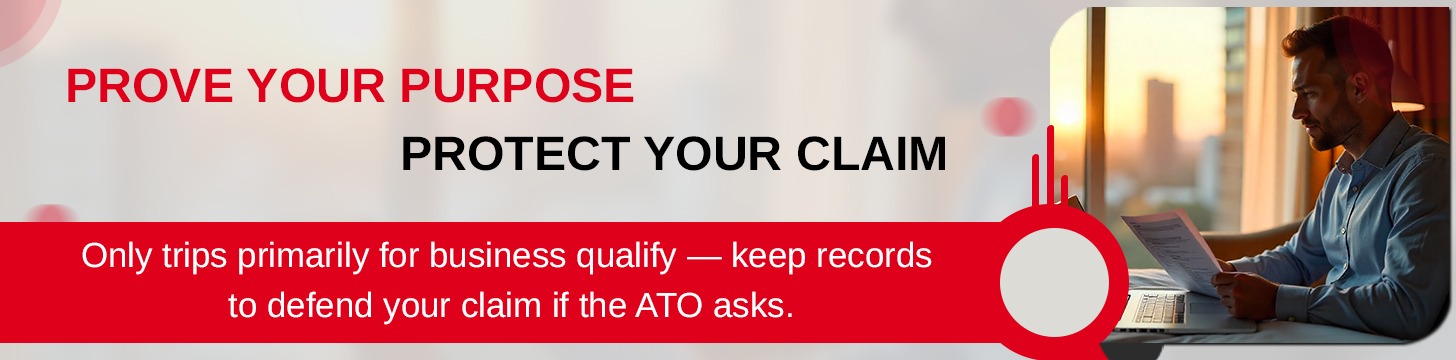
To claim business travel deductions in Australia it’s not enough to just travel for work; you must be able to prove that the primary purpose of the trip was indeed business related. The ATO is strict on this requirement and failing to meet the business purpose criteria can result in deductions being denied. This section explains how to ensure your travel qualifies and what evidence you need to provide.
1. What is Business Purpose
The trip must be primarily for business activities like meeting clients, attending conferences or conducting work related research.
Example: A business owner attending a marketing seminar in Sydney to learn new strategies for their business can claim the travel expenses because the trip was for business development.
But if you combine business with personal travel (e.g. attending a business meeting and then going on a holiday) only the business portion of the trip can be claimed.
Example: If you travel to Melbourne for a work conference but then spend the weekend sightseeing you can only claim the airfare, accommodation and transport expenses for the days spent at the conference.
2. Documenting Business Purpose
To satisfy the ATO you must keep detailed records to prove the business purpose of your trip.
Business Itinerary: An itinerary outlining the dates, locations and nature of business activities is essential.
Example: A contractor traveling to visit a client should keep a copy of the meeting agenda, client correspondence or a letter from the client confirming the purpose of the visit.Business Meetings and Events: If attending a conference or seminar keep the event registration details, conference schedules or any other evidence that proves the event is business related.
Example: Attending a trade show related to your industry where you meet potential suppliers should be supported with conference tickets and receipts.
3. Personal vs. Business Travel
- When you’re juggling business and personal travel, its vital to split your expenses carefully. The portion of your trip that’s purely personal can’t be claimed.
Example: Let’s say you take a 7-day business trip and tack on 3 extra days for personal fun. You can only claim the expenses linked to the business part of your trip – for instance, 4/7ths of accommodation and airfare costs.
4. Mixed-Use Trips: How to Separate the Bills
- The key to dealing with business and leisure travel that overlaps is keeping track of your spending so you can separate the costs.
Example: If you’re on a business trip that involves 2 days work and 2 days of chill-out time, you only claim expenses for the business days. So, for example, you’d divide your accommodation costs 50/50 between business and personal use.
Airfares, Accommodation, and Other Travel Costs
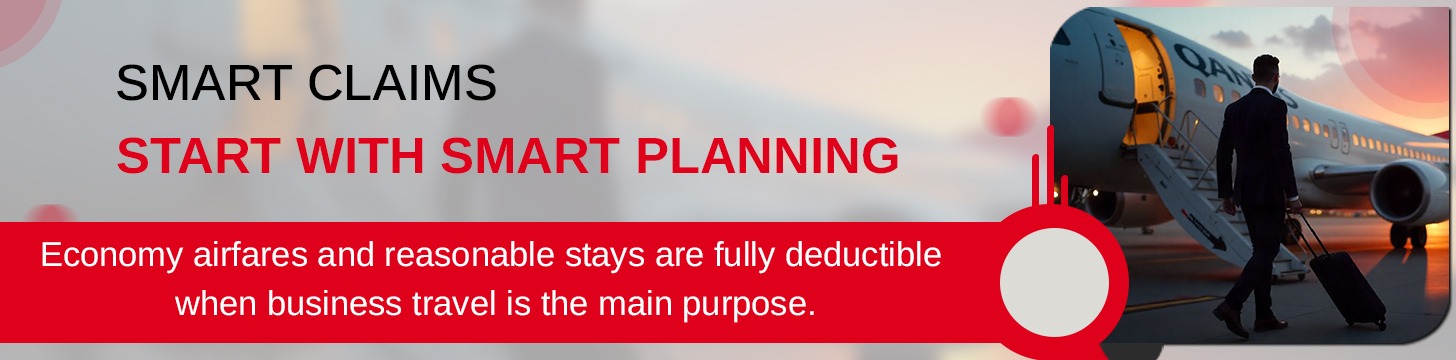
When you’re traveling for business, its essential to know which airfares, accommodation and other travel expenses you can claim as a tax deduction. The ATO lets businesses claim these expenses, but only if they’re genuinely linked to the work you’re doing. In this section, we’ll run through the common travel expenses and give you a rundown on what can be claimed and what to watch out for.
1. Airfares
Airfares are probably the most straightforward expense to claim when you’re traveling on business. As long as your trip is primarily for business, the whole cost of your airfare – including taxes and fees – is deductible.
Example: If you fly from Sydney to Brisbane for a meeting with a client, the whole cost of your airfare (including the return ticket) is fair game for a tax deduction – as long as you can show that the trip’s main purpose was business.
Booking Class: The ATO tends to let you claim economy airfares, but be wary of booking business or first-class tickets – they might think the expense is excessive and only allow a partial claim.
Example: Let’s say a senior executive books a business-class flight for a 2-hour domestic hop – the ATO might question whether this is really necessary for the business purpose, and only allow a partial deduction.
2. Accommodation
Accommodation costs, such as hotel stays or short-term rentals, are deductible as long as they’re really necessary for the business side of things.
Example: A business consultant traveling to Melbourne for a 3-day conference can claim the cost of their hotel stay, including any extra fees like parking or internet.
Keeping it Reasonable: The ATO expects accommodation costs to be reasonable for where you are and how long you’re staying. If you book a swanky hotel for just a few nights, they might start to wonder whether this really is necessary.
Example: If you stay in a luxury hotel for a business meeting when there are cheaper options nearby, be prepared for the ATO to ask some questions and maybe only allow a partial claim.
3. Other Travel Expenses
Getting Around: Other transport costs like car hire, taxis and public transport are deductible as long as you’re using them for business. So, if you use a taxi to get to the airport, or rent a car to get to a meeting, you can claim the costs.
Transport Costs: This includes expenses for getting to and from airports, meeting locations and other business-related destinations.
Parking and Tolls: If you pay for parking or tolls while traveling for work, you can claim those too.
Example: A contractor driving to a construction site can claim the cost of parking and tolls.
4. Incidentals
- Incidentals like baggage fees, internet charges and phone calls for business purposes are also deductible.
- Example: A business traveler pays to check in extra luggage for a work trip. The cost of that luggage fee is deductible.
- Example: A client calls from a hotel room to discuss a project. The phone charges for that call are deductible.
What’s Deductible and How to Maximize Your Claim?
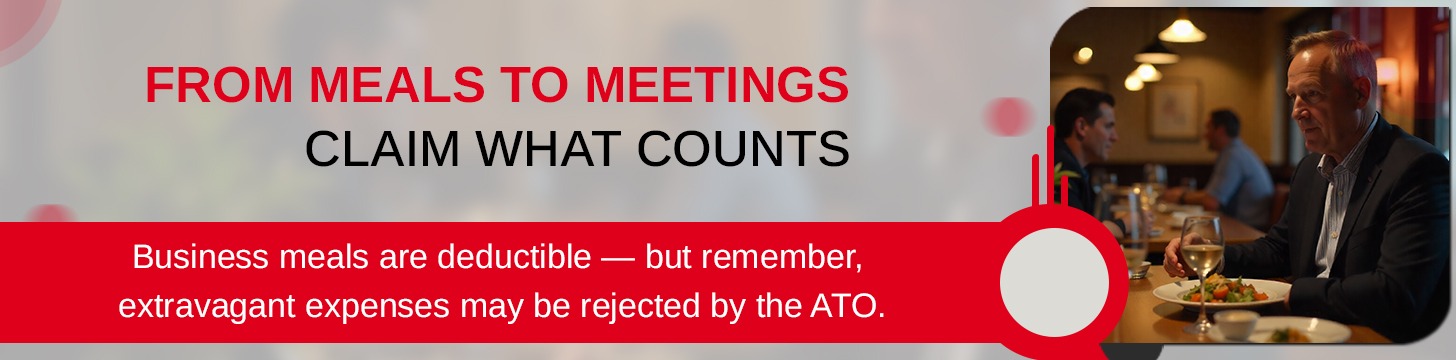
Meals and entertainment are common expenses when traveling for work, but they come with rules around what can and can’t be claimed. The ATO allows businesses to claim these expenses but only if they are directly related to business activities. Knowing what meals and entertainment expenses are deductible is key to being compliant and maximizing your tax deductions. This section covers what can be claimed and how to claim.
1. Meals
Business Meals: Meals while traveling for work can be deductible if they are directly related to business activities.
Example: If you take a client out to lunch during a business trip, the cost of the meal is deductible as long as the primary purpose of the meal is business.
Overnight Stays: When traveling overnight for work, meals for breakfast, lunch and dinner are usually deductible.
Example: A consultant attending a 2 day conference can claim the cost of meals while staying at a hotel as long as they are for business purposes.
Entertainment Meals: When entertaining clients, business partners or colleagues the ATO allows deductions for the meal costs but there are limits.
Example: Taking a potential client out to dinner is deductible but if the meal is extravagant or unreasonable the ATO may question the claim.
2. Entertainment
Client Entertainment: Entertainment expenses while entertaining clients or potential business partners are deductible if they are directly related to the business purpose.
Example: Hosting a golf day or taking clients to a sporting event is deductible if the primary purpose is to build business relationships or discuss business matters.Limits: Client entertainment can be claimed but the ATO has limits on what can be claimed especially for extravagant or unreasonable expenses.
Example: If you host a business event at a high end venue the ATO may question if the expenses are reasonable. Keep records and justify the business purpose of the expense.
Home Office Travel and Commuting Deductions: Exploring Tax Benefits for Home-Based Businesses
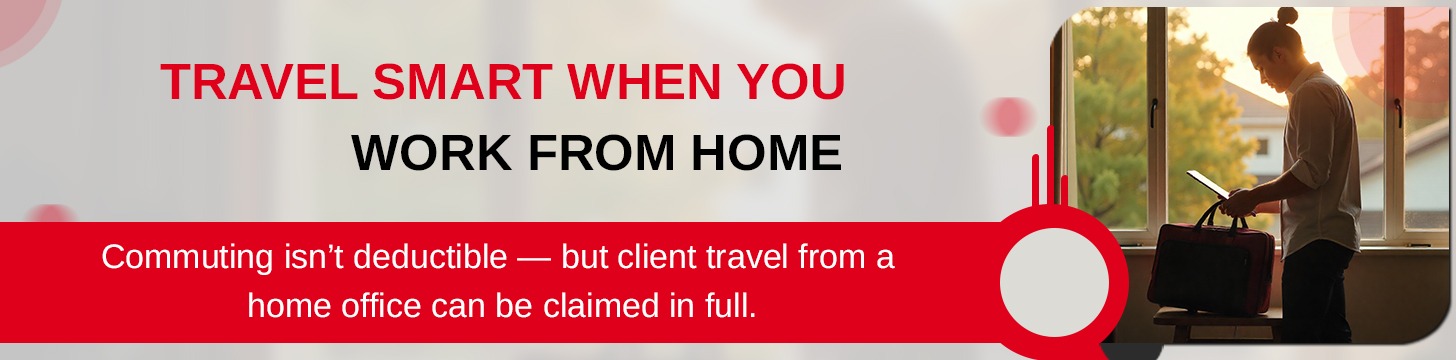
Home-based businesses and employees who work from home may also be eligible for business travel deductions when they travel for work. But there are specific rules around claiming commuting and travel between home and work. This section explains the details of claiming travel deductions for home office owners and workers who need to travel for business purposes.
1. Home Office Travel vs. Commuting
Home Office Travel: If you run a business from home and need to travel to meet clients, attend business meetings or visit work sites, these trips can be claimed as business travel expenses.
Example: A consultant who works from home but travels to meet clients in another city can claim the airfare, accommodation and transport costs incurred during the business trip.
Commuting to a Regular Workplace: However, commuting between your home and a regular workplace (i.e. where you typically do your work) is generally not deductible.
Example: If you work from home but commute daily to a secondary office or a client’s office, the travel between home and the office is considered personal commuting and is not deductible.
2. Travel Between Multiple Work Locations
If you work from home but need to travel between different job sites, clients or offices for business reasons, the travel between these locations is generally deductible.
Example: A home-based contractor travels from their home office to a construction site and then to a meeting with a client. The travel expenses incurred for these trips are deductible.
This applies even if your home is the starting point of your journey, as long as the travel is for a legitimate business purpose.
Example: A web developer who works from home and attends client meetings in various locations can claim the travel costs for each leg of the trip.
3. Claiming Travel for Home Office Employees
For employees who work from home, it’s a bit more complex. Travel expenses can only be claimed if the travel is for business purposes, such as client meetings, training or conferences.
Example: An employee who works remotely but is required to attend a work-related seminar in another city can claim travel expenses, including airfare, accommodation and meals, as long as these costs are directly related to the business event.
Note: Commuting from home to the employer’s office is generally not deductible, unless the travel is for a specific business task (e.g. attending a meeting) that could not have been done from home.
4. Mixed-Use Travel (Business and Personal)
If you mix business and personal travel, only the business part can be claimed.
Example: A home-based business owner travels to a distant city for a client meeting and stays a few extra days for personal reasons, only the business part of the trip (airfare and conference fees) can be claimed.
5. Keeping Track of Expenses for Home Office Travel
If you want to successfully claim travel expenses because you work from home, you need to keep solid records. This means documenting why each trip was necessary for work, keeping all receipts, and keeping a travel log with the details of every business trip.
Example: If you’re a freelancer who goes to a conference, you’ll want to keep the conference registration, your flight tickets, and a calendar with the conference dates to show the conference was work-related.
Record-Keeping Requirements for Business Travel Claims
Keeping proper records is super important if you want to claim business travel expenses without any issues in Australia. The ATO needs you to keep good records and proof for any business travel expenses you claim – this section breaks down the kind of records you need and why.
1. Keeping Receipts and Invoices
Receipts : You’ll need to save receipts for every business travel expense – that’s flights, hotels, meals, transport, and anything else you might splurge on.
Example: If you’re going to a conference in Melbourne, make sure you keep the receipt for your flight, hotel, taxis, and meals.
Invoices : If you pay for something in advance or through a business account – like a conference registration or car hire – keep the invoice to prove you bought it.
Example: If you rent a car for your business trip, keep the rental agreement or invoice to prove the expense.
2. Keeping Track of Your Itinerary and Bookings
Travel Itinerary : Your travel itinerary needs to show the dates, locations, and what you did on each leg of your trip. This helps prove the trip was mostly for business.
Example: If you’re attending multiple meetings in different cities, keep your itinerary with the business meetings’ locations and times listed.
Booking Confirmations : Keep the emails or receipts for flight bookings, hotel reservations and any other services you pre-booked.
Example: If you’re going on site visits, keep the booking confirmations for your hotel and transport services to prove the business purpose of your trip.
3. Keeping Meeting Notes and Agendas
Meeting Agendas : If you’re attending business meetings, keep a copy of the agenda, invitation or any other details about the meeting.
Example: If you’re going to a conference for work, keep the event agenda to prove the business purpose of your travel.
Meeting Notes : Notes or minutes from meetings can also help prove the travel was for business.
Example: If you’re meeting with potential clients, keep a meeting summary or email chain to prove the trip was tied to business development.
4. Travel Logs and Diaries
Daily Travel Log : Keeping a daily travel log can be a real game-changer when it comes to substantiating business activities on your trip. If you’re going to be doing a mix of business and personal stuff, it’s crucial you record what’s what – and what’s business-related.
Example: So, say you’re combining a business trip with some well-deserved holiday time. You should make sure to document each business-related activity – be that a meeting, site visit or client chat – in your log.
Mileage Log : If your personal vehicle doubles as your business wheels during the trip, keep a mileage log with dates, destinations and the reason it was for business each time you get behind the wheel.
Example: A home-based consultant driving between client locations needs to keep tabs on the miles driven and the business reason for each journey – that way it’s clear what you can claim.
5. Splitting Personal and Business Expenses
When your trip is split 50/50 between business and personal activites (or whatever that ratio ends up being!), you need to keep separate records for business and personal expenses. Remember, only the business-related expenses get to be deducted.
Example: Say you’re a business owner who turns what’s supposed to be a business trip into a mini-holiday on the side. Make sure you keep separate receipts and documentation for business and personal expenses – like meals, accommodation and travel costs – so it’s clear which is which.
The ATO wants you to prove what proportion of costs are for business and what’s personal.
Example: Let’s say you’re on a 10 day trip and 6 of those days are business-related – in that case you’d be able to claim 60% of your travel and accommodation costs as deductible, because that’s the business portion of the trip.
6. Credit Card Statements and Bank Statements
Paper Trail: Your credit card or bank statements can be useful to have as proof of expenses for business travel – these statements should match up with the receipts and invoices you collect.
Example: If you paid for a meal or transport with your business credit card, your statement can be used to back it up, along with your receipts.
Special Cases and Deductions for Overseas Trips
If you’re going to be gallivanting across borders for business, there are a few more things to consider when it comes to claiming tax deductions. Overseas travel can add an extra layer of complexity and expense.
The Australian Taxation Office (ATO) has its own rules for claiming deductions for overseas travel, and it’s worth getting up to speed on these to avoid any headaches and make the most of your claims. This bit’s all about special considerations for international business travel and the deductions you can claim.
1. Travel Expenses for Overseas Trips
Flights : Just like domestic travel, airfares for international business trips are deductible – provided the trip’s main reason is business.
Example: A business owner flying from Sydney to New York for a trade conference can claim their airfare, because the trip’s mainly about business.
Accommodation : Accommodation costs for business-related stuff while you’re abroad are deductible. Just like with domestic travel, though – only claim for the business bit.
Example: A consultant staying in Paris for a week-long business seminar can claim the hotel costs, but they need to make sure to leave out any personal vacation time and exclude those expenses.
2. Apportioning Business and Personal Costs
When you’re combining work and play on an international trip, its super important to get the expenses right. You can only claim business costs and not your personal outlays.
Example: Say you head to Tokyo for a 4 day business meeting but also decide to hang around for 3 days of sightseeing on your own. You can only claim 4 out of 7 of your accommodation and travel bills as a business expense.
Keeping track of what you did and when during your trip will help to make sure you get your business costs right.
3. Currency conversion and exchange rates
Currency Exchange: When you’re paying for international expenses in foreign currencies, you have to convert these back into Australian dollars for tax purposes. The ATO wants you to use a genuine exchange rate.
Example: Lets say you’re at a conference in London and pay for meals and transport in pounds. These costs need to get converted back into Australian dollars based on the exchange rate when you made the payment.
Using Bank Statements: To help with currency conversion, its handy to use credit card statements, bank statements, or receipts that actually show the conversion rate at the time of purchase.
Example: If you’re attending a seminar in Berlin you can use your bank statement to show the AUD value of any euros you spent on meals and transport.
4. Travel insurance and other related expenses
Travel Insurance: If you take out travel insurance specifically for business trips, these premiums are also deductible.
Example: If you buy travel insurance for a trip to Europe that covers any potential medical or trip cancellation costs related to your work you can claim the cost of the insurance as a business expense.
Other Related Expenses: Expenses like international phone calls, internet for work, and shipping costs for business materials can be claimed if you can show they were directly related to your business activities.
Example: If you have to get internet access at your hotel while attending a conference in another country you can claim that as a business expense.
5. Keeping track of your international travel
Just like with domestic trips, keeping a detailed record of your travels is a must. Write down the dates, locations, what you were up to business wise, and your expenses for each part of your trip.
Example: If you’re a consultant and you attend meetings in multiple cities in Europe you should keep a log of each meeting, the cities you visited, and what you spent on travel for each part of your trip.
Keep all your receipts, booking confirmations, and itineraries handy to back up your claims, especially if you are dealing with foreign currencies or multiple destinations.
Common Mistakes to Avoid When Claiming Business Travel Deductions
Claiming Business Travel Deductions – A Guide to Avoiding Common Mistakes
Claiming business travel deductions can definitely cut down your tax bill, but make one mistake and you could be looking at disallowed claims, penalties, or even an audit from the Australian Tax Office (ATO).
To avoid all that bother and keep your travel claims on track, it’s crucial to steer clear of the pitfalls that business owners and employees often fall into when claiming business travel deductions. Below are the most common mistakes to watch out for and some tips on how to stay out of trouble.
1. Mixing Personal and Business Expenses
Apportioning Mixed Travel – This is one of the most common mistakes people make – they fail to accurately split expenses when a trip includes both business and leisure activities. Only the business bits of the trip are deductible.
Example : You go to a conference for three days and then hang around for a family holiday – what you can actually claim is the expenses for the business days (like your airfare and accommodation) and not the whole lot.
Tip: Keep a clear record of your business activities (e.g. meetings, conferences, site visits) and separate them from leisure activities like sightseeing or visiting family. The more detail the better for your records.
2. Not Keeping Adequate Records
Lack of Documentation – Another thing to watch out for is failing to keep the necessary paperwork – the ATO want to see evidence, such as receipts, invoices, travel itineraries, and meeting agendas, to keep track of your claims.
Example: You claim a taxi fare from hotel to a client meeting but you can’t find the receipt – the ATO might just knock it back.
Tip: Keep all your receipts, bank statements, booking confirmations and travel logs in a safe place and organised so you can access them easily.
3. Claiming Non-Deductible Commuting Costs
Commuting Between Home and Work – Don’t even think about claiming the cost of your daily commute – it’s considered personal and not deductible.
Example: You work from home but drive to the office to see a client – sorry, that trip to work isn’t a business expense.
Tip: If you’re traveling to a different business location (such as a job site or a client meeting)then you can claim the travel costs.
4. Overstating Your Deductions
Excessive Claims – Don’t be tempted to claim more than you’re entitled to, especially when it comes to things like meals, accommodation or entertainment – the ATO has a keen eye out for excessive claims and might flag them for a close look.
Example: Claiming a luxury hotel stay or a high-end restaurant meal for a simple client meeting could lead to some major trouble – an audit.
Tip: Be sensible with your claims and make sure they’re in line with what others in your industry would expect for a similar trip.
5. Getting Currency Conversion Wrong
Foreign Currency – When traveling abroad it’s easy to get your sums wrong – make a mistake with currency conversion and you might end up with a claim that’s a million miles from your actual costs.
Example: If you go to Europe and spend some euros on meals, you need to convert those costs to Aussie dollars using the exchange rate on the day the transaction happened.
Tip: Use bank statements, credit card statements or online currency converters to ensure your conversions are accurate and consistent.
6. Not Separating Meals and Entertainment
Personal Meals During Business Trips: It’s important to separate business meals and entertainment from personal meals especially when the trip involves both work and leisure.
Example: If you extend a business trip for personal time, only the meals during the business days are deductible. Personal meals during leisure days can’t be claimed.
Tip: Track and document which meals and entertainment expenses are directly related to business activities and make a clear distinction between business and personal expenses.
7. Not Claiming All Eligible Expenses
Overlooking Small Expenses: Small travel related expenses such as tolls, parking fees and baggage fees are often overlooked but are still deductible.
Example: A business traveller may forget to claim parking fees incurred when visiting a client’s office or the toll charges for driving between meetings.
Tip: Make sure all travel expenses no matter how small are documented and included in your claim. These small deductions can add up over time.
Conclusion: Staying Compliant While Maximising Your Travel Deductions
Business travel deductions can save you a lot of tax but success depends on accuracy, documentation and compliance with ATO guidelines.
Only travel directly related to business purposes – such as meetings, conferences or site visits – is deductible. Personal travel or mixed-use trips must be apportioned to avoid over-claiming.
Keep detailed records like receipts, itineraries, invoices and travel logs to substantiate your claims and prevent ATO disputes. Each expense should clearly show its business purpose.
Airfares, accommodation, meals and transport costs are deductible if reasonable and properly documented. For international travel make sure currency conversions and business days are recorded correctly.
By planning ahead, separating personal from business costs and keeping complete records, Australian taxpayers can claim legitimate deductions – turning business travel expenses into tax savings while staying fully compliant with the law.
FAQ – Tax Deductions for Business Travel
1. What Business Travel Expenses Are Tax-deductible for Australians?
When it comes to business travel, Australians can claim expenses for a range of things directly related to work. These are:
- Flights for flights necessary for work.
- Accommodation costs for hotel stays during business trips.
- Meals eaten while travelling for work, with some conditions.
- Car hire or public transport fares for business use during travel.
- Travel insurance for business trips.
Make sure you keep accurate records of these expenses, including receipts and documentation, as the tax office requires proof that these costs are work related. Without records, the deductions won’t be allowed.
2. Can I Claim Deductions for Both Business and Personal Travel Expenses?
Yes, if your travel is both business and personal, you can still claim. But you can only claim the expenses for the business part of the trip.
For example, if you go to a conference for work and then extend your stay for personal reasons, you should only claim the costs for the conference or other work activities.
This applies to:
- Flights, where only the business part of the trip is deductible.
- Accommodation, where only the nights spent on work activities can be claimed.
Make sure you break down the personal and business parts of your travel expenses.
3. Are Travel Meals Fully Deductible for Business Trips in Australia?
Meals during business travel are 50% deductible if eaten in Australia. This is the general rule from the tax office.
If you attend a business seminar or event where meals are provided, you may be able to claim the full cost of those meals.
For international travel, you can claim the full cost of meals related to the business part of your trip but documentation is key.
4. Do I Need to Keep Records of My Business Travel Expenses for Tax Deductions?
Yes, you must keep records of your business travel expenses for at least 5 years. These records are essential if you get audited by the tax office.
Key documents to keep:
- Receipts for travel related costs like transport, meals and accommodation.
- Itineraries showing the business nature of your trip.
- A logbook or diary if you’re using your car for business travel, detailing the work related travel.
Without records, the deductions you claim won’t be allowed.
5. Can I Claim Travel Expenses if I Work From Home and Travel to Client Meetings?
Yes, if you work from home and travel to client meetings, you can claim the travel expenses for those trips.
For example, if you drive to a client meeting, you can claim fuel or public transport fares. If you’re using your car, you can claim car expenses for the business part of the trip.
Remember if you’re combining personal and business travel, you’ll need to apportion the expenses and only claim the business part.