






Rental yield is the annual rental income of a property as a percentage of its market value or purchase price. It’s a key metric for investors to see how well the asset is performing compared to its cost.
In Australia’s 2025 property market where rents have grown 44% in 5 years, yield is a hot topic. The national median gross yield is 4.3%, up from 3.8% in 2023 due to tight supply and record population growth.
A higher yield means a stronger cash flow position to manage mortgage repayments and maintenance costs. But yield isn’t everything — some high-yield properties may have slower capital growth.
Example:
- A $500,000 apartment renting for $500/week produces $26,000 annually — 5.2% gross yield.
- A $900,000 Sydney home renting for $700/week gives only 4.0% yield but may grow faster in value.
Takeaway: Investors should balance income with long term growth, use yield as a performance indicator not the sole decision maker.
What is Rental Yield (and Why It Matters)
Rental yield is a key metric for property investors: It shows how much rental income a property generates compared to its value. In Australia, calculating and understanding yield helps you compare investment opportunities, assess cash flow and benchmark against the market. With rising rents, low vacancy rates and shifting values, yield gives you a clearer picture of income return not just capital growth.
What Are Typical Yields in Australia?
To give you context:
- Average gross rental yield in Australia is around 4.92% (Q3 2025) according to Global Property Guide
- Some sources say 5 year average of ~3.56% for Australia overall – though this can vary by location and property type.
- In regional or high-yield suburbs the numbers can be much higher: for example, rural WA units have delivered ~8.3% in some cases.
- In capital cities the yields are lower: for example, Sydney houses ~2.6% and units ~3.9%
From this you can see that a “good yield” in Australia varies by location, property type and investment strategy.
Why This Matters for Your Property Investment Strategy?
- A higher yield (all else equal) means more rental income per dollar invested, which means stronger cash flow and ability to cover loan servicing, maintenance and vacancies.
- Yield helps you compare properties across markets. For example a regional location with higher yield but lower growth vs a metropolitan property with lower yield but higher growth.
- It also flags risk: very low yields mean you’re relying on growth to deliver your return and more exposed to interest rate rises, rental market weakness or vacancy risk.
- Knowing the average yield in your target area helps you set realistic expectations and avoid overpaying for a property that produces weak income relative to cost.
Key Takeaways for Investors
- Always work out both the gross and net rental yield – which gives you a quick snapshot with the gross, but the true income return after costs with the net.
- Compare your property’s yield against the local average (city, suburb, houses vs units) to see how it stacks up.
- Bear in mind that in major capital cities, yields are often lower than in regional or less expensive markets because property values are higher.
- Decide what kind of property strategy you’re aiming for – are you chasing higher returns through income, or hoping to make some capital gains instead?
- Use yield as one of several factors (vacancy rates, rent growth, maintenance, tax settings, infrastructure, demand from tenants) – but consider it a solid starting point to work from.
Gross vs Net Rental Yield – Knowing the True Value of Your Property’s Income
Understand the difference between gross and net rental yield and you’ll save yourself from getting overly optimistic about your returns. Gross yield tells you income before expenses, while net yield gives you the real profit after factoring in all ownership costs.
Example Calculation
| Type | Formula | Result |
| Gross Yield | (Annual Rent ÷ Property Value) × 100 | (26,000 ÷ 500,000) × 100 = 5.2% |
| Net Yield | ((Annual Rent – Annual Costs) ÷ Property Value) × 100 | ((26,000 – 7,000) ÷ 500,000) × 100 = 3.8% |
Why does it matters?
- Your gross yield is great for a quick comparison of properties.
- However net yield is what really shows how a property is performing after you’ve subtracted all the things like maintenance and repairs, insurance, council rates, strata levies, and periods of vacancy.
Example: you might think a high-gross-returning property is a great find, but when you factor in all the maintenance and the downtime, it might not be as great as you thought – it’s a lesson in knowing the true income efficiency of a property.
What Is Considered a Good Rental Yield in Australia? – Setting Realistic Investor Benchmarks

In Australia, a pretty good rental yield for residential properties is around 4-6% – but of course it depends on the city, property type, and market conditions.
This benchmark is just a guide to help you work out if your property is doing better or worse than the average in your area.
The national median gross yield has just ticked up to 4.3% – that’s up from 3.8% in 2023 due to more people chasing houses and a pretty tight supply – but still, yields can vary a fair bit depending on where you are.
| Location | Average Gross Yield (2025) | Market Insight |
| Sydney | 3.3% | High property values dilute yield |
| Melbourne | 3.5% | Gradual recovery post-pandemic |
| Brisbane | 4.6% | Migration-driven rental demand |
| Perth | 5.1% | Tightest vacancy rates in Australia |
| Regional QLD/NSW | 5.5–7.0% | Affordable prices, strong returns |
Out in the regions, you get a mix of affordable prices and pretty strong yields, but you do have to be prepared for periods of vacancy and higher volatility
Why it’s not the same everywhere:
- Property types: apartments tend to have higher yields than houses because they’re often cheaper to buy
- Location: the more regional the area, the stronger the yields tend to be, but also the higher the risks
- Market timing: when the rental market is picking up, your yields might end up rising too
Good Rental Yield for Residential Property
In Australia, a good rental yield for residential property is between 3% and 5% per annum depending on the location and property type.
Regional areas like Toowoomba, Ballarat and Townsville get higher yields around 5% to 6% while metro hubs like Sydney and Melbourne are around 3% to 4%.
Example
A $600,000 property earning $550 per week is a 4.8% gross yield. Strong yields are found in suburbs with growing infrastructure, affordable housing and low vacancy rates.
Key factors affecting residential yields are:
- Tenant demand and local employment growth.
- Property maintenance costs and council rates.
- Interest rate movements impacting investor returns.
Rental income and potential capital growth makes residential property a foundation for long term Australian investors.
Good Rental Yield for Commercial Property
Commercial property in Australia generally gets higher yields, around 6% to 9% per annum depending on the asset type and tenant quality.
Warehouses, retail outlets and office spaces in high traffic areas get premium rental agreements.
Example
A $1 million warehouse leased at $80,000 per annum is an 8% gross yield, well above residential averages. But commercial property comes with longer vacancy risks and higher upfront costs.
Why yields are higher
- Longer lease terms (3-10 years) with fixed annual rent increases.
- Tenants paying outgoings like insurance and maintenance.
- Less management hassles with professional leasing arrangements.
For investors looking for cash flow and diversification, commercial property can be a great addition to residential holdings — balancing risk while increasing overall portfolio yield.
Factors That Influence Rental Yield – From Location to Lifestyle Appeal
The rental yield is influenced by a range of factors that have a hand in both the rental income and property value.
Understanding what drives these elements helps investors to identify the best opportunities – those with the right balance of profit and potential for growth.
1. Finding the Right Location
Areas that are close to the city centre, schools, transport hubs and job zones tend to attract the highest rents. Take Brisbane’s inner suburbs for example – Newstead or West End average a 4.8% yield, while the outer regions like Ipswich do even better at 5.2% due to being more affordable & having a growing population.
2. Choosing The Right Property
- Apartments tend to do well with a 4-5% yield because they are generally cheaper to buy.
- Houses on the other hand show a bit more sluggish growth in yield, but their value tends to go up more quickly.
3. What Vacancy Rates Do to Your Yield
A major factor driving rental yield is the number of vacant properties. In 2025, places like Perth and Adelaide are doing really well with vacancy rates under 1%, which gives landlords a strong hand in negotiations.
On the flip side, regions with a high number of vacant properties like inner Melbourne, tend to even lower the yield down to 3.5% for a bit.
4. Something That Attracts Tenants
Modern homes with aircon, parking, or a bit of outdoor space do really well at attracting the people you want as tenants and getting you a higher rent.
5. How Interest Rates and Economy Affect Your Yield?
When the RBA puts up interest rates, costs go up for investors, but the housing supply is limited, and that keeps demand for rent strong. Meaning your yields don’t take a massive hit.
Improving Rental Yield – Smart Upgrades That Pay for Themselves

You don’t always have to buy a new property to boost your rental yield. Often, some smart, strategic upgrades can make a big difference.
In today’s tight rental market, even small improvements can lift your weekly rent by 5-15%, which in turn boosts your cash flow and keeps your tenants happy for longer.
1. Focus on the Hotspots
Upgrading your kitchen and bathroom tend to give you the highest return on investment. For instance, a $10,000 kitchen renovation in Brisbane could get you an extra $40-$60 per week in rent – which means an extra $2,000-$3,000 a year and pay back your costs in 4-5 years.
2. Add in the Features That Tenants Want
Tenants these days are looking for:
- Aircon and heating systems
- A dishwasher and some modern appliances
- Secure parking or a bit of outdoor entertainment space
- Pet-friendly policies
Domain’s 2025 Rental Report found that properties that allow pets are able to command up to 10% higher rent in the city.
3. Get Your Listing Right
You need to get that listing right to get tenants in quickly and make sure you’re not out of pocket. Even an extra week of vacancy per year can cost you nearly 2%.
4. Review Your Costs
Switching to a lower mortgage rate or cutting back on management fees can instantly get your net yield up.
Comparing Yields Across Cities – The 2025 Australian Rental Landscape
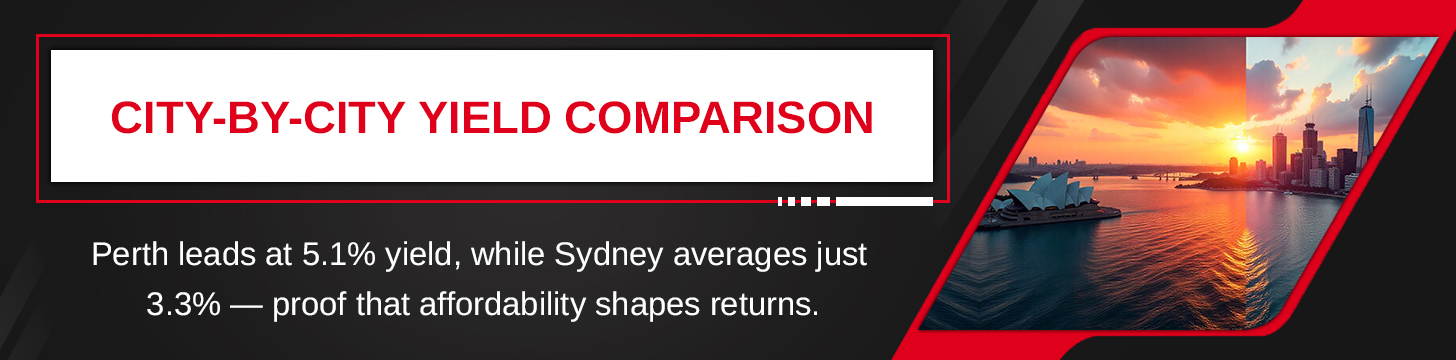
The rental yields vary a lot from city to city because of all the differences in housing affordability, migration trends and supply-demand balance. As of mid-2025, the national data from SQM Research is showing that yields have actually gone up across nearly all the major markets.
| City | Average Gross Yield (2025) | Trend | Key Insight |
| Sydney | 3.3% | Stable | High prices keep yields low despite rising rents |
| Melbourne | 3.5% | Recovering | Inner-city supply slowly tightening |
| Brisbane | 4.6% | Growing | Interstate migration and affordability boost demand |
| Perth | 5.1% | Strong | Vacancy below 1%, strongest landlord market nationally |
| Adelaide | 4.4% | Steady | Consistent rent growth across metro suburbs |
| Darwin | 6.0% | High | Smaller market but strong resource-linked demand |
| Regional QLD/NSW | 5.5–7.0% | High | Lower entry prices and strong rental pressure |
Why the variation?
- Perth is doing really well because of the extreme shortage of rentals and booming population growth.
- Sydney and Melbourne have high property prices, which means lower yields but more capital growth
- Regional areas are attracting investors looking for higher cash flow, but there is a higher risk of vacancies.
Example: A $450,000 property in Toowoomba that rents out for $500 a week gives you a yield of 5.7%, while a $900,000 Sydney apartment renting for $650 a week only manages 3.7%.
Balancing Yield and Growth – The Smart Investor’s Dilemma
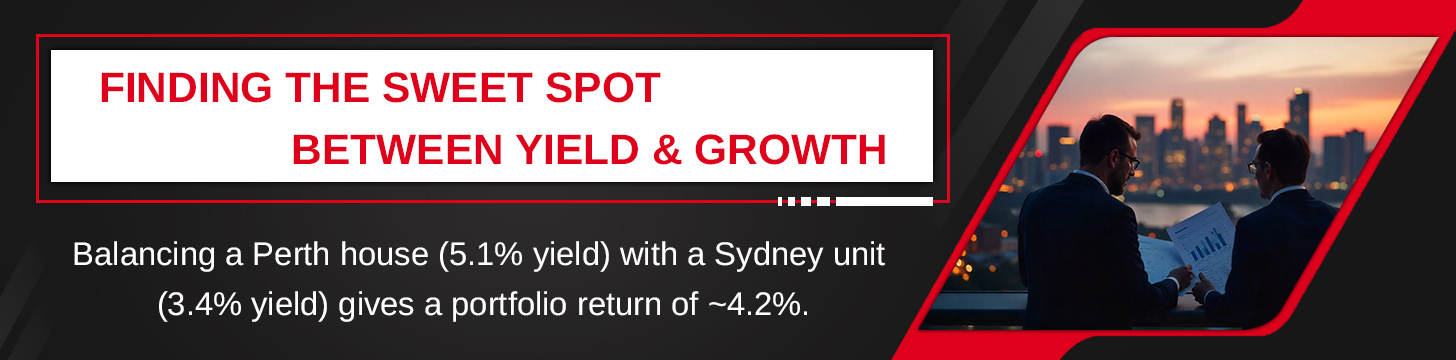
For Australian investors, the real challenge is finding that magic middle ground between rental return and capital growth. A high yield can give you a strong short-term cash flow, but without growth your long term wealth creation is going to be pretty limited. Conversely, low-yield, high-growth areas are going to strain your cash flow in the short term but might just pay off in the long run.
Example Comparison
| Property Type | Yield | 10-Year Growth (avg) | Example Market |
| Metro Sydney Apartment | 3.4% | 70% | Long-term equity gains |
| Perth House | 5.1% | 40% | Strong cash flow, moderate growth |
| Regional QLD Unit | 6.2% | 25% | High income, limited appreciation |
Why It Makes Sense to Balance Both?
- Keep the lights on: A bit of cash flow from your yield can cover mortgage and expenses, especially when interest rates go up.
- Grow your money: Growth compounds your wealth over time through equity gains and refinancing power.
- Spread your risk: Holding a mix of metro and regional assets reduces your exposure to a single market downturn.
For instance, an investor with one Perth house (5.1% yield) and one Sydney unit (3.4% yield) gets a portfolio yield of about 4.2% while still reaping the benefits of Sydney’s stronger capital growth.
Tools and Metrics – How to Calculate and Compare Yields Accurately
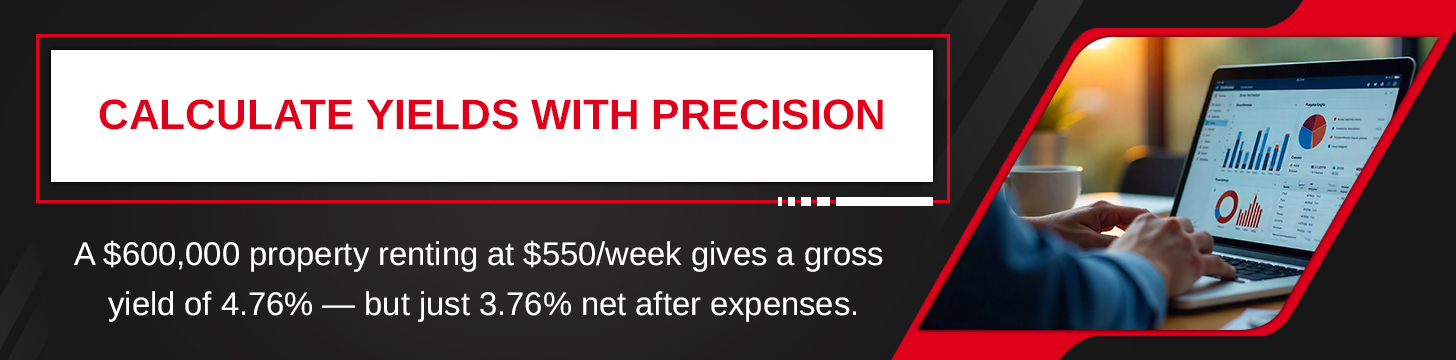
You can’t just whip up a quick calculation and call it a day – investors need to rely on real tools and solid formulas to assess performance.
A small difference in expenses or property value can distort what you see as profitability so using trustworthy resources helps keep your numbers on track.
1. Calculation Methods
The core formula is pretty simple but still effective:
Rental Yield (%) = (Annual Rent ÷ Property Value) x 100
But real investors prefer Net Yield, which takes out annual costs such as:
- Council rates and insurance
- Maintenance and property management fees
- Strata levies or utilities
Example:
A property worth $600,000 renting for $550 a week brings in $28,600 a year. After $6,000 in annual costs, the net yield is 3.76% – lower than the 4.76% gross yield but a lot more realistic.
Click here to know more about “How to Calculate Rental Yield?”
2. Reliable Data Tools
- SQM research offers historical rent and vacancy trend charts.
- Domain and REA suburb profiles track average rent and value movements.
- ABS Housing Index helps with big picture forecasting.
By cross checking a few different tools, investors can spot yield outliers and avoid getting misled by over-estimated yields.
Future Trends Shaping Rental Yields – 2026 and Beyond
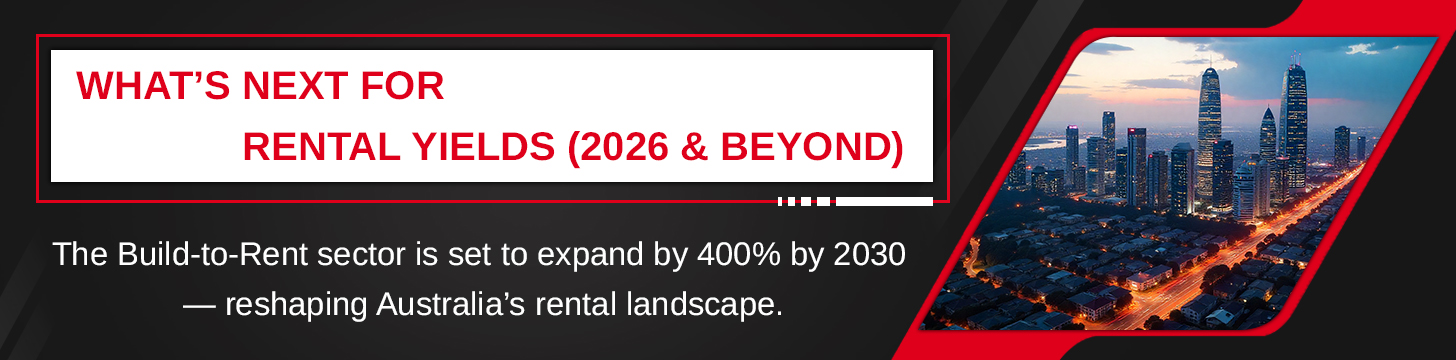
Australia’s rental yield scene is changing fast, driven by big economic shifts, population growth and a lack of housing. Between 2026 and 2030 a few major trends are going to change how investors think about rental performance and returns.
1. Build-to-Rent Getting Big
The BTR sector is expected to grow by over 400% by 2030 (Urbis data), bringing professionally managed rentals in cities like Melbourne, Sydney and Brisbane. While it adds to the supply, it also attracts high income tenants potentially stabilising yields in urban areas.
2. More People Moving Regional
Post pandemic lifestyle changes are fueling demand for regional areas. Places like the Sunshine Coast, Geelong and Newcastle are reporting yields of 5-6% – a lot higher than the metro average. Affordable housing and improved infrastructure are making regional investments more and more appealing.
3. Tech and AI in Valuation
Platform like PropTrack’s analytics is now using AI to help investors predict rent changes and find yield hotspots more accurately.
4. Economic and Interest Rate Outlook
Forecasts hint at the possibility of some RBA rate cuts kicking in mid-2026 which should give investors a bit of a boost and get them buying again. Lower interest rates do bring down borrowing costs which will have a slight effect of reducing yields, but we can’t forget the fact that property prices are still going to be driven up by the aged housing shortage that just won’t seem to go away.
Conclusion – Making the Right Choice for Your Investment Journey
Both managed funds and index funds are vital components in putting together a mixed investment portfolio in Australia. The main advantage of managed funds is the expert hand that picks and chooses your investments for you, taking active decisions and potentially outperforming the market when conditions are right.
On the other hand, index funds take a much more straightforward approach, offering low fees, simplicity and consistent returns that pretty much mirror the market as a whole, like the S&P/ASX 200. These types of funds are perfect for those investors who are in it for the long haul, are disciplined and prefer not to have to worry about their investments on a day to day basis & want to just sit back and watch the compounding magic happen.
The smart way to go for a lot of Australians is to find a balance – using index funds as the stable foundation that keeps things on track & then add in managed funds for targeted growth to really push those investments forward. This sort of mix-up can bring a solid combination of reliability and opportunity to the party.
Ultimately your choice should be about what you are comfortable with taking on in terms of risk, your investment time frame and how confident you are in the suitability of active versus passive investing. With an ever-changing investment landscape, making informed, cost-conscious decisions now is the key to setting yourself up for sustainable long term financial growth down the road.
FAQ: What is a Good Rental Yield
1. How Do You Calculate Rental Yield?
Rental yield is your return on investment from rental income compared to the property’s value.
Formula: (Annual Rental Income ÷ Property Value) × 100
For example a property worth $600,000 earning $600 per week generates $31,200 per year, which is a 5.2% yield. This helps investors compare performance between different properties.
2. What Factors Affect Rental Yield in Australia?
Several things can impact rental yield:
- Location: Close to schools, jobs and public transport increases demand.
- Vacancy rates: Lower vacancy rates means stable returns.
- Property type: Apartments yield more; houses provide stronger capital growth.
- Interest rates: Rate changes affect investor demand and rental prices.
- Local market trends: Shifts in migration, infrastructure and employment all play a role.
Knowing these drivers helps investors find consistent income producing properties.
3. Which Areas Have the Best Rental Yields in Australia?
High yielding areas are often outside major capital cities. Markets like Darwin, Perth and parts of regional Queensland and South Australia get 5%+ yields due to tight supply and strong demand.
Sydney and Melbourne are around 3% to 4% due to higher property values and slower rent growth.
4. Is a High Rental Yield Always a Good Sign?
Not necessarily. A very high yield may mean higher risk, such as limited capital growth or lower quality tenant demand.
While high yields boost cash flow, balanced properties that combine steady rental income with long term growth are the best investment. Smart investors look for sustainable returns not just short term gains.